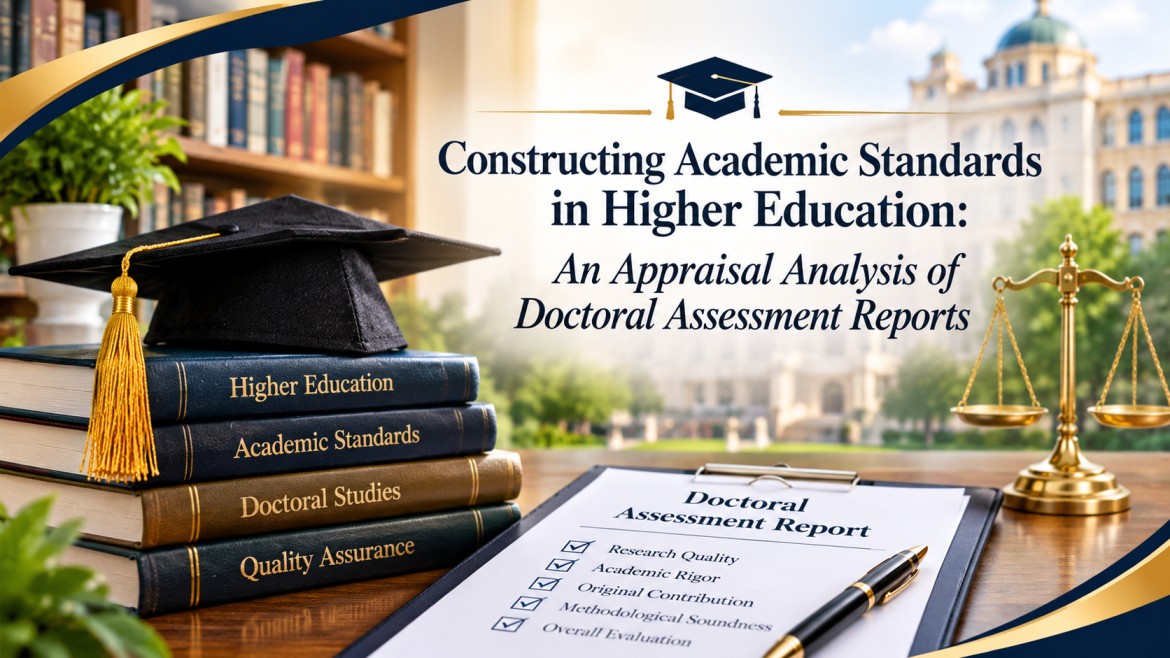
Constructing Academic Standards in Higher Education: An Appraisal Analysis of Doctoral Assessment Reports
DOI:
https://doi.org/10.68024/7v0jh441Keywords:
doctoral reports, evaluation, academic discourse, higher education, attitude subsystemAbstract
Doctoral assessment reports are a crucial yet understudied form of institutional academic communication, through which examiners not only evaluate doctoral research but also convey judgements about the research. This study investigates how evaluative language is used in doctoral assessment reports in the English departments of two Pakistani universities. Drawing on the Attitude subsystem of Appraisal Theory (Martin & White, 2005), the study examines how examiners use Appreciation, Judgment, and Affect to express approval, critique, and recommendations about the thesis and the candidate within assessment discourse. Qualitative discourse analysis reveals dominant patterns of Appreciation related to research quality, alongside Judgment related to candidates’ scholarly abilities, and fewer nuanced occurrences of Affect. The evaluative comments indicate recurring attention to qualities such as originality, methodological adequacy, theoretical grounding, coherence, and contribution to knowledge. These patterns demonstrate how doctoral reports serve as communication tools that extend beyond individual assessment, through discursive practices in which expectations concerning doctoral-level scholarly quality are articulated and communicated. By positioning doctoral assessment in an under-represented national context, the study extends research on evaluative discourse in higher education. It demonstrates how examiner reports contribute to the communication of academic standards within doctoral education.
Downloads
References
Afful, J. B. A. (2020). The discourse of thesis assessment reports in a disciplinary community
at the University of Cape Coast: An exploratory study. AFRREV LALIGENS: An International Journal of Language, Literature and Gender Studies, 9(1), 117-134. https://doi.org/10.4314/laligens.v9i1.11 DOI: https://doi.org/10.4314/laligens.v9i1.11
Ashraf, A., & Zaki, S. (2019). Language assessment in higher education: Challenges and DOI: https://doi.org/10.30971/pje.v36i3.437
consequences. Pakistan Journal of Education, 36(3), 163–185. https://doi.org/10.30971/pje.v36i3.671 DOI: https://doi.org/10.30971/pje.v36i3.671
Aziz, A., Mahmood, M., Ahmad, S., & Akbar, N. (2021). A corpus-based study of genre
specific discourse: M.A. TEFL thesis abstracts., Journal of Language and Linguistic Studies 17(2), 884- 898. https://doi.org/10.17263/jlls.904084 DOI: https://doi.org/10.17263/jlls.904084
Batool, S., Ali, A. F., & Safdar, M. (2022). What Pakistani doctoral students want? A
qualitative exploration of their research experiences. Global Knowledge, Memory and
Communication, 71(4/5), 355–369. https://doi.org/10.1108/gkmc-04-2021-0074 DOI: https://doi.org/10.1108/GKMC-04-2021-0074
Bednarek, M. (2009). Cognitive and discursive perspectives. Language and social cognition:
Expression of the social mind, 206, 395. https://doi.org/10.1075/pc.17.1.05bed DOI: https://doi.org/10.1075/pc.17.1.05bed
Bilal, A., & Shehzad, W. (2019). Genre Analysis: Studying Authorial Stance in the Pakistani
Research Articles of Business and Management Sciences. International Journal of English Linguistics, 9(1), 455–471. https://doi.org/10.5539/ijel.v9n1p455 DOI: https://doi.org/10.5539/ijel.v9n1p455
Boud, D., & Falchikov, N. (Eds.). (2007). Rethinking assessment in higher education: DOI: https://doi.org/10.4324/9780203964309
Learning for the longer term. Routledge. https://www.taylorfrancis.com/books/9781134152155
Boud, D., & Lee, A. (Eds.). (2009). Changing Practices of Doctoral Education. Routledge. https://doi.org/10.4324/9780203870488 DOI: https://doi.org/10.4324/9780203870488
Chetcuti, D., Cacciottolo, J., & Vella, N. (2022). What do examiners look for in a PhD
thesis? Explicit and implicit criteria used by examiners across disciplines. Assessment & Evaluation in Higher Education, 47, 1-16. https://doi.org/10.1080/02602938.2022.2048293 DOI: https://doi.org/10.1080/02602938.2022.2048293
Creswell, J. W., & Creswell, J. D. (2017). Research design: Qualitative, quantitative, and
mixed methods approaches. Sage publications.
Crotty, M. (2020). Foundations of social research: Meaning and perspective in the research DOI: https://doi.org/10.4324/9781003115700
process. Routledge.
Dally, K., Holbrook, A., Lovat, T., & Budd, J. (2019). Examiner feedback and Australian doctoral examination processes. The Australian Universities' review, 61(2), 31-41. https://files.eric.ed.gov/fulltext/EJ1228240.pdf
Deng, Z., & Xie, B. (2022). Analysis of Audiences' Attitudes towards Product Placement in
Short Videos Based on Appraisal Theory: A Case Study of the Bilibili Platform. International Journal of Social Science Studies 10(4), 83–96. https://doi.org/10.11114/ijsss.v10i4.5633 DOI: https://doi.org/10.11114/ijsss.v10i4.5633
Fatima, N., Raza, A., & Ahmad, M. (2023). Linguistic Variations in the Abstracts of
Pakistani Dissertations: A Multidimensional Analysis across Disciplines. University of Chitral Journal of Linguistics and Literature, 7, 50–80.
https://doi.org/10.33195/btm19817
Firouzi, R., & Farahzad, F. (2025). A Systematic Review of Appraisal Theoretical Research
in Translation Studies Published Between 2017 and 2024. Iranian Journal of Translation Studies, 22(88), 44–60. https://doi.org/10.5040/9781350447905.0014 DOI: https://doi.org/10.5040/9781350447905.0014
Forde-Leaves, N., Walton, J., & Tann, K. (2023). A framework for understanding assessment practice in higher education. Assessment & Evaluation in Higher Education, 48(8), 1076–1091. https://doi.org/10.1080/02602938.2023.2169659 DOI: https://doi.org/10.1080/02602938.2023.2169659
Fuoli, M. (2018). A stepwise method for annotating appraisal. Functions of language, 25(2), 229-258. https://doi.org/10.1075/fol.15016.fuo DOI: https://doi.org/10.1075/fol.15016.fuo
Holbrook, A., Bourke, S., Lovat, T., & Fairbairn, H. (2008). Consistency and Inconsistency
in PhD Thesis Examination. Australian Journal of Education, 52(1), 36–48.
https://doi.org/10.1177/000494410805200103 DOI: https://doi.org/10.1177/000494410805200103
Holbrook, A., Bourke, S., Fairbairn, H., & Lovat, T. (2014). The focus and substance of formative comment provided by PhD examiners. Studies in Higher Education, 39(6), 983-1000. https://doi.org/10.1080/03075079.2012.750289 DOI: https://doi.org/10.1080/03075079.2012.750289
Johnston, S. (1997). Examining the examiners: An analysis of examiners’ reports on doctoral
theses. Studies in Higher Education, 22(3), 333–347. https://doi.org/10.1080/03075079712331380936 DOI: https://doi.org/10.1080/03075079712331380936
Kashiha, H. (2024). Stance-taking in peer reviewer and thesis examiner feedback on Iranian
scholarly contributions. Journal of English for Academic Purposes, 68, 101364.
https://doi.org/10.1016/j.jeap.2024.101364 DOI: https://doi.org/10.1016/j.jeap.2024.101364
Khan, I. U., Imtiaz, A., Shahzad, A. K., Khan, S., & Amina, S. (2020). Emerging Academic
Identities in a Foreign Context: Pakistani International Doctoral Students’ Responses to Supervisory Feedback in New Zealand. Linguistica Antverpiensia, 1, 1481–1502.
Kobayashi, S., & Emmeche, C. (2023). What makes a good PhD thesis? Norms of science as
reflected in written assessments of PhD theses. Assessment & Evaluation in Higher Education, 48(8), 1310–1324.
https://doi.org/10.1080/02602938.2023.2200917 DOI: https://doi.org/10.1080/02602938.2023.2200917
Liu, G. (2025). A positive discourse analysis based on the attitude system in appraisal
theory—Taking Chang'an as an example. Literature, Language and Cultural Studies, 1(3), 44-57. https://doi.org/10.63313/llcs.9037 DOI: https://doi.org/10.63313/LLCS.9037
Martin, J. R., & Rose, D. (2007) Working with Discourse: Meaning beyond the Clause. (2nd ed.). Continuum.
Martin, J. R., & White, P. R. R. (2005). The language of evaluation: Appraisal in English.
Palgrave Macmillan. https://doi.org/10.15718/discog.2016.23.2.171 DOI: https://doi.org/10.15718/discog.2016.23.2.171
Nausheen, M., & Zulfiqar, A. Z. Z. (2024). Assessment Practices at PhD Level: A
Phenomenological Study of the PhD Scholars’ Experiences. Journal of Education and Humanities Research, 17(1), 50-62. http://jehronline.uob.edu.pk/journal/index.php/jehr/article view/334/314
Nerad M (2020) Governmental Innovation Policies, Globalisation, and Change in Doctoral Education Worldwide: Are Doctoral Programmes Converging? Trends and Tensions. In: Cardoso S, Tavares O, Sin C, et al. (eds) Structural and Institutional Transformations in Doctoral Education: Social, Political and Student Expectations. Cham: Springer International Publishing, pp. 43–84. Available at: https://doi.org/10.1007/978-3-030-38046-5_3 (accessed 13 November 2025). DOI: https://doi.org/10.1007/978-3-030-38046-5_3
Prastikawati, E. F. (2021). Attitude perspective in BBC News’ article: An appraisal analysis.
Journal of English Language Studies, 6(2), 122-137. https://doi.org/10.30870/jels.v6i2.10280 DOI: https://doi.org/10.30870/jels.v6i2.10280
Rafi, M. S., & Moghees, A. (2023). Writing challenges, causes, and strategies to facilitate the
doctoral dissertation-writing process: A qualitative analysis. International Social Science Journal, 73(247), 139–156. https://doi.org/10.1111/issj.12367 DOI: https://doi.org/10.1111/issj.12367
Rehman, A. U., Khan, M. I., & Waheed, Z. (2023). Academic Reading and Writing
Challenges Faced by Doctoral Students in Peshawar, Pakistan: A Qualitative Study. UMT Education Review, 6(2), 52-71. https://doi.org/10.32350/uer.62.03 DOI: https://doi.org/10.32350/uer.62.03
Rehman, A. U., Khan, M. I., & Ahmad, S. M. (2025). Ethical and Quality Concerns in Social
Science Doctoral Research Studies: A Case Study in Pakistan. Journal of Academic Ethics, 23(3), 389-403. https://doi.org/10.1007/s10805-024-09573-0 DOI: https://doi.org/10.1007/s10805-024-09573-0
Rofess, S., & Mahmood, M. A. (2015). An Investigation of Generic Structures of Pakistani
Doctoral Thesis Acknowledgements. Journal of Education and Practice, 6(28), 128–143. https://files.eric.ed.gov/fulltext/EJ1081244.pdf
Shrestha, P. N. (2022). Examining evaluative language used in assessment feedback on business students’ academic writing. Assessing Writing, 54, 100664. https://doi.org/10.1016/j.asw.2022.100664 DOI: https://doi.org/10.1016/j.asw.2022.100664
Starfield, S., Paltridge, B., McMurtrie, R., Holbrook, A., Bourke, S., Fairbairn, H., Kiley, M.,
& Lovat, T. (2015). Understanding the language of evaluation in examiners’ reports on doctoral theses. Linguistics and Education, 31, 130–144.
https://doi.org/10.1016/j.linged.2015.06.004 DOI: https://doi.org/10.1016/j.linged.2015.06.004
Walter, M. (2013). The nature of social science research. In M.Walter (Ed.), Social research
methods (4th ed, pp. 3–24). Oxford University Press.
Wang, Y., & Ni, J. (2020). Analysis of attitude resources in news headlines of The Economist from the perspective of the appraisal theory. US-China Foreign Language, 18(6), 195–201. https://doi.org/10.17265/1539-8080/2020.06.005 DOI: https://doi.org/10.17265/1539-8080/2020.06.005
Downloads
Published
Issue
Section
License
Copyright (c) 2026 Fouzia Goreja (Corresponding author), Prof. Dr. Wasima shehzad (Author)

This work is licensed under a Creative Commons Attribution 4.0 International License.
Authors retain the copyright and full publishing rights of their work. All articles published in Scholar Insight Journal are licensed under the Creative Commons Attribution 4.0 International License (CC BY 4.0).
Under this license, readers are permitted to read, download, copy, distribute, print, search, link to the full texts, and reuse the published articles for any lawful purpose, including adaptation and commercial use, provided that appropriate credit is given to the original author(s), the source of publication, and the license terms are properly acknowledged.
The journal retains the right of first publication while authors maintain ownership of their intellectual property rights without restrictions.