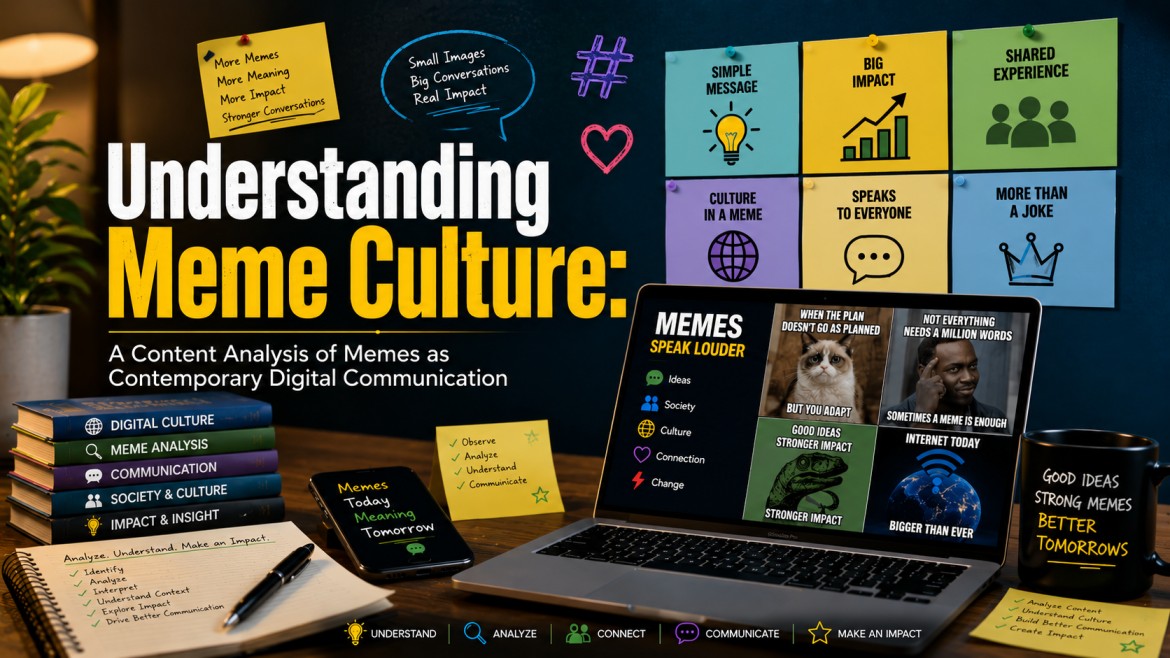
Understanding Meme Culture: A Content Analysis of Memes as Contemporary Digital Communication
DOI:
https://doi.org/10.68024/xf3e4b98Keywords:
Meme Culture, Digital CommunicationAbstract
While many studies have discussed the role of memes in communication, there is very little systematic, empirically validated research that has explored the role of memes in the Pakistani online communities. This study examines the role of online memes as a form of communication, the function of multimodal elements in the construction of meaning, and the role of memes in the formation and/or reflection of collective identity and ideology. The study adopts a convergent parallel approach by integrating critical discourse analysis of ten internet memes spread during the 2025 India-Pakistan tensions and the eight semi-structured interviews with participants, using a three-dimensional model by Fairclough as well as multimodal discourse analysis and social semiotics. The results indicate that humor is not an alternative to substantive communication but its main means of expression; political criticism, expression of identity and emotional processing is carried out through the interaction of text, picture, culture and platform resources, all of which are associated with humor. The study offers an empirical description of the Pakistani digital meme culture and suggests that memes are a serious and sophisticated language of public discourse that has implications for media literacy education.
Downloads
References
Akondo, A. O., Ugangu, W., & Mutwiri, I. (2026). Memes as digital activism tools for political accountability in Kenya: A study of TikTok and X (Formerly Twitter) during the 2024 Finance Bill Protests. International Journal of Research and Innovation in Social Science, 100(3), 291. https://doi.org/10.47772/ijriss.2026.100300291
Ali, L. F. (2018). Globalization or standardization: Exploring English's centre of gravity. Journal of Social Sciences & Interdisciplinary Research, 7(2), 72-85.
Ali, L. F., & Ali, S. F. (2026a). Digital literacy as a gateway to lifelong learning for underprivileged youth: Insights from a case study. IARS' International Research Journal, 16(1). https://doi.org/10.51611/iars.irj.v16i1.2026.279
Ali, L. F., & Ali, S. F. (2026b). Public speaking anxiety in academic contexts: A biopsychosocial analysis and emerging interventions. IARS' International Research Journal, 16(1). https://doi.org/10.51611/iars.irj.v16i1.2026.280
Ali, L. F., & Habib, Z. (2025). Deconstructing the impact of gender, culture and society on public speaking anxiety: Perspectives of psychologists and business studies students. International Journal of Emerging Business and Economic Trends, 4(1), 56-72.
Ali, L. F., & Nauman, S. (2026). Addressing public speaking anxiety: A pedagogical action research approach. Educational Action Research. Taylor and Francis.
Ali, L. F., Siraj, J., & Ali, M. F. (2024). AI-driven vocabulary development in ESL context: Advancing autonomous learning through technology. Journal of Asian Development Studies, 13(4), 1067-1082. https://doi.org/10.62345/jads.2024.13.4.86
Ali, L. F., & Zaki, S. (2019). Exploring vocabulary learning strategies across ESL/EFL contexts: Juggling between the experiential and traditional modes of learning. Journal of Education and Educational Development, 6(2).
Bhandari, B. (2025). Memes as a form of digital communication and cultural commentary (Bachelor's thesis, Department of English and Humanities, BRAC University).
Braun, V., & Clarke, V. (2006). Using thematic analysis in psychology. Qualitative Research in Psychology, 3(2), 77-101. https://doi.org/10.1191/1478088706qp063oa
Creswell, J. W., & Creswell, J. D. (2018). Research design: Qualitative, quantitative, and mixed methods approaches (5th ed.). SAGE.
Dawkins, R. (1976). The selfish gene. Oxford University Press.
Denisova, A. (2019). Internet memes and society: Social, cultural, and political contexts. Routledge.
Dennett, D. C. (1991). Consciousness explained. Little, Brown and Company.
Devitska, A., & Bryla, A. (2025). Modern Internet memes as a new form of digital communication. Bicultural Education: Tradition and Modernity, 11(41), 99-111. https://doi.org/10.52058/2786-6165-2025-11(41)-99-111
Dwivedi, S. K. (2023). Social media memes: A study of its impact on intercultural communications. International Journal of Development Research, 13(1), 61307-61311. https://doi.org/10.37118/ijdr.26159.01.2023
Fairclough, N. (1995). Critical discourse analysis: The critical study of language. Longman.
Halim, S., & Sari, M. (2024). Visual language and identity in digital youth culture: A socio-semiotic study of memes among Indonesian Gen Z. Communicata: Journal of Communication Studies, 2(3), 775. https://doi.org/10.61978/communica.v2i3.775
Hassan, M. U., Jabeen, S., & Iqbal, M. (2023). Exploring the role of visual semiotics analysis in digital communication for ideological purposes: A study of memes and emojis. Pakistan Languages and Humanities Review, 7(2), 1-15.
Highfield, T., & Leaver, T. (2016). Instagrammatics and digital methods: Studying visual social media, from selfies and GIFs to memes and emoji. Communication Research and Practice, 2(1), 47-62. https://doi.org/10.1080/22041451.2016.1155332
Hofstadter, D. R. (1979). Gödel, Escher, Bach: An eternal golden braid. Basic Books.
Huang, X., Han, Y., Ran, Y., Yang, Y., & Yang, Y. (2024). The rise of cross-language internet memes: A social semiotic analysis. The Journal of American Folklore, 129(125), 729125. https://doi.org/10.1086/729125
Knobel, M., & Lankshear, C. (2007). Online memes, affinities, and cultural production. In M. Knobel & C. Lankshear (Eds.), A new literacies sampler (pp. 199-227). Peter Lang.
Kovalev, N. A. (2026). The COLD WAR concept in visual English-language political discourse: Semiotic representation and pragmatics of internet memes and political cartoons (2020-2025). Russian Journal of Communication, 1(46), 8-28. https://doi.org/10.24833/2410-2423-2026-1-46-8-28
Lestari, D. A., Primagara, M., Sari, S. A., Meilina, A., Fauziah, S., Sugesti, A. I., Nasywa, A., & Salwi, A. D. (2024). Meme culture: A study of humor and satire in digital media. International Journal of Advanced Multidisciplinary Research and Studies, 4(4), 134-140. https://doi.org/10.62225/2583049X.2024.4.4.3013
Mukhtar, S., Ayyaz, Q. U. A., Khan, S., Bhopali, A. M. N., Saifullah, Mehmood Sajid, M. K., & Babbar, A. W. (2024). Memes in the digital age: A sociolinguistic examination of cultural expressions and communicative practices across border. Educational Administration: Theory and Practice, 30(6), 1443-1455. https://doi.org/10.53555/kuey.v30i6.5520
Qadduri, H. H. (2026). Stylistics of humor in internet memes: A pragmatic and multimodal analysis. Journal of English and Humanities, 16(1), 866. https://doi.org/10.32792/jedh.v16i1.866
Rezeki, T. I., Sagala, R. W., & Rabukit, R. (2024). From humour to impact: Internet memes in political discourse through (de)legitimization. Evolutionary Studies in Imaginative Culture, 788. https://doi.org/10.70082/esiculture.vi.788
Shifman, L. (2014). Memes in digital culture. MIT Press.
Shifman, L. (2021). Memes in a new world (2nd ed.): On the social lives of internet memes. MIT Press.
Wu, X., & Fitzgerald, R. (2025). Humor, culture, and compliance in health crisis communication: A multimodal analysis of government-produced memes for a local community during a global pandemic. International Journal of Communication, 14, 1386674. https://doi.org/10.1177/14703572251386674
Younis, D., & Amer, M. (2026). Memeing the masses: Internet memes as educational tools and expressions of public opinion on social media. American Journal of Media and Mass Communication, 12(2), 4. https://doi.org/10.30958/ajmmc.12-2-4
Zhang, Y. (2025). Visual appeals of popular YouTube short-form video memes. Research Studies, 6(3), 84. https://doi.org/10.71222/rs6zrt84
Zulli, D., & Zulli, D. J. (2022). Extending the internet meme: Conceptualizing technological mimesis and imitation publics on the TikTok platform. New Media & Society, 24(8), 1872-1890. https://doi.org/10.1177/1461444820983603
Downloads
Published
Issue
Section
License
Copyright (c) 2026 Mahnoor Farhan Ali, Bushra Ali, Haniya Riaz (Author)

This work is licensed under a Creative Commons Attribution 4.0 International License.
Authors retain the copyright and full publishing rights of their work. All articles published in Scholar Insight Journal are licensed under the Creative Commons Attribution 4.0 International License (CC BY 4.0).
Under this license, readers are permitted to read, download, copy, distribute, print, search, link to the full texts, and reuse the published articles for any lawful purpose, including adaptation and commercial use, provided that appropriate credit is given to the original author(s), the source of publication, and the license terms are properly acknowledged.
The journal retains the right of first publication while authors maintain ownership of their intellectual property rights without restrictions.