
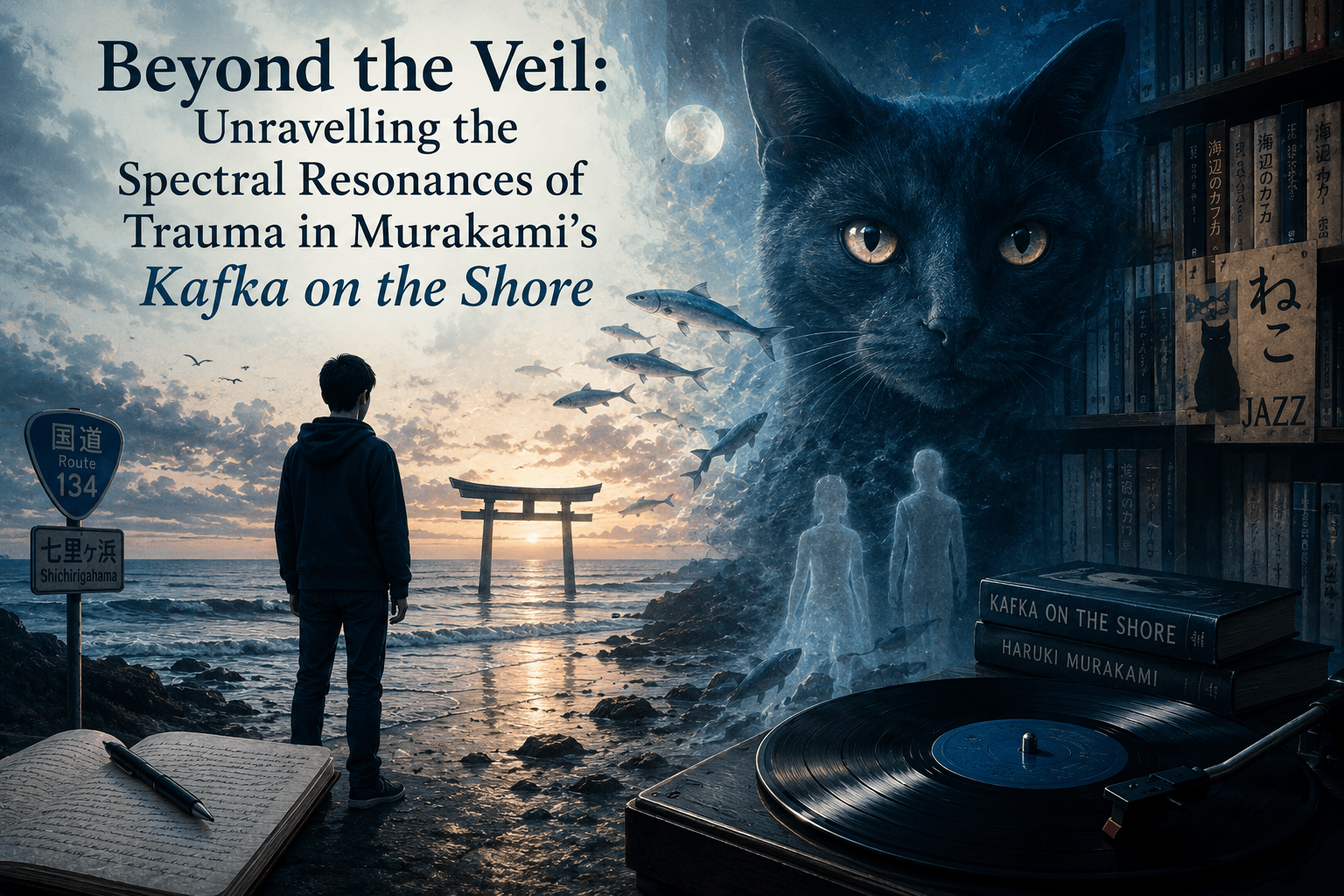
Beyond the Veil: Unravelling the Spectral Resonances of Trauma in Murakami’s Kafka on the Shore
DOI:
https://doi.org/10.68024/zk5mr973Keywords:
Spectral resonances, Psychoanalysis, Trauma, Hauntology, TraceAbstract
This study underscores the psychological exploration of hauntology in Murakami’s novel Kafka on the Shore. The objective of this research is to mirror the spectral reverberation of trauma that refuses to remain buried silently. Moreover, by following the theoretical frameworks of hauntology and Psychoanalysis, this study situates the novel within mystical realms where unheard echoes and traumas contribute to shaping one’s personality. This study employs qualitative analysis incorporating close reading and thematic interpretation. Aforementioned, approach allows for profound comprehension of ways in which Murakami’s novel reevoke haunting space, thus echoing the unheard and unseen. Through revealing spectral undertones, this study justifies the narrative power as a dual force for illuminating the hidden recesses of human persona. Though this study paves the way to unravel the spectral essences underlying human psyche, however, the prospect of more compelling research in this direction is undeniable.
Downloads
References
Bal, M. (1985). Narratology: Introduction to the theory of narrative. University of Toronto Press.
Cruz, D. E. C. (2018). An intertextual study of Haruki Murakami’s Kafka on the Shore. SMART MOVES JOURNAL IJELLH, 6(9), 569–581. https://ijellh.com/index.php/OJS/article/view/4980
Derrida, J. (1994). Specters of Marx: The state of the debt, the work of mourning, and the New International (P. Kamuf, Trans.). Routledge.
Gioia, T. (n.d.). Kafka on the Shore by Haruki Murakami. The New Canon. Retrieved October 7, 2021, from http://www.thenewcanon.com/kafka_on_the_shore.html
Khurana, V., & Thakur, R. (2020). Privileging oddity and otherness: A study of Haruki Murakami’s Kafka on the Shore. Rupkatha Journal on Interdisciplinary Studies in Humanities, 12(3), 1–6.
Murakami, H. (2005). Kafka on the Shore (P. Gabriel, Trans.). Vintage.
Orgad, Y. (2017). On wabi sabi and the aesthetics of family secrets: Reading Haruki Murakami’s Kafka on the Shore. Culture & Psychology, 23(1), 52–73.
Putri, S. A. (2021). Women’s subordination in Kafka on the Shore [Bachelor’s thesis, Universitas Brawijaya]. UB Repository. https://repository.ub.ac.id/185571/
Raj, B. F. B., & Shalini, K. B. (2024). Diving into the enigma: The magic realism of Haruki Murakami’s Kafka on the Shore. Shanlax International Journal of Arts, Science and Humanities, 11(S2), 69–72. https://doi.org/10.34293/sijash.v11iS2-March.7513
Rubin, J. (2002). Haruki Murakami and the music of words. Vintage.
Vanniarajan, T., & Navaneethamani, V. (2023). Reflections of post-war Japan in Haruki Murakami’s Kafka on the Shore. Shodha Prabha, 47, 48–51.
Yeung, V. (2016). Time and timelessness: A study of narrative structure in Murakami Haruki’s Kafka on the Shore. Mosaic: An Interdisciplinary Critical Journal, 49(1), 145–160. https://doi.org/10.1353/mos.2016.0000
Downloads
Published
Issue
Section
License
Copyright (c) 2026 Wajeeha Nabi Ahmed, Dr. Saima Bashir(Corresponding Author) (Author)

This work is licensed under a Creative Commons Attribution 4.0 International License.
Authors retain the copyright and full publishing rights of their work. All articles published in Scholar Insight Journal are licensed under the Creative Commons Attribution 4.0 International License (CC BY 4.0).
Under this license, readers are permitted to read, download, copy, distribute, print, search, link to the full texts, and reuse the published articles for any lawful purpose, including adaptation and commercial use, provided that appropriate credit is given to the original author(s), the source of publication, and the license terms are properly acknowledged.
The journal retains the right of first publication while authors maintain ownership of their intellectual property rights without restrictions.