
Uncovering Ideological Polarization: A Comparative Critical Discourse Analysis of Social Media Posts of Representatives of Iran and US During Iran-US conflict 2026
DOI:
https://doi.org/10.68024/9qj16942Keywords:
Critical Discourse Analysis (CDA), Fairclough’s 3D Model, Iran-US conflict, War Discourse, Media Framing, Military Dominance, HegemonyAbstract
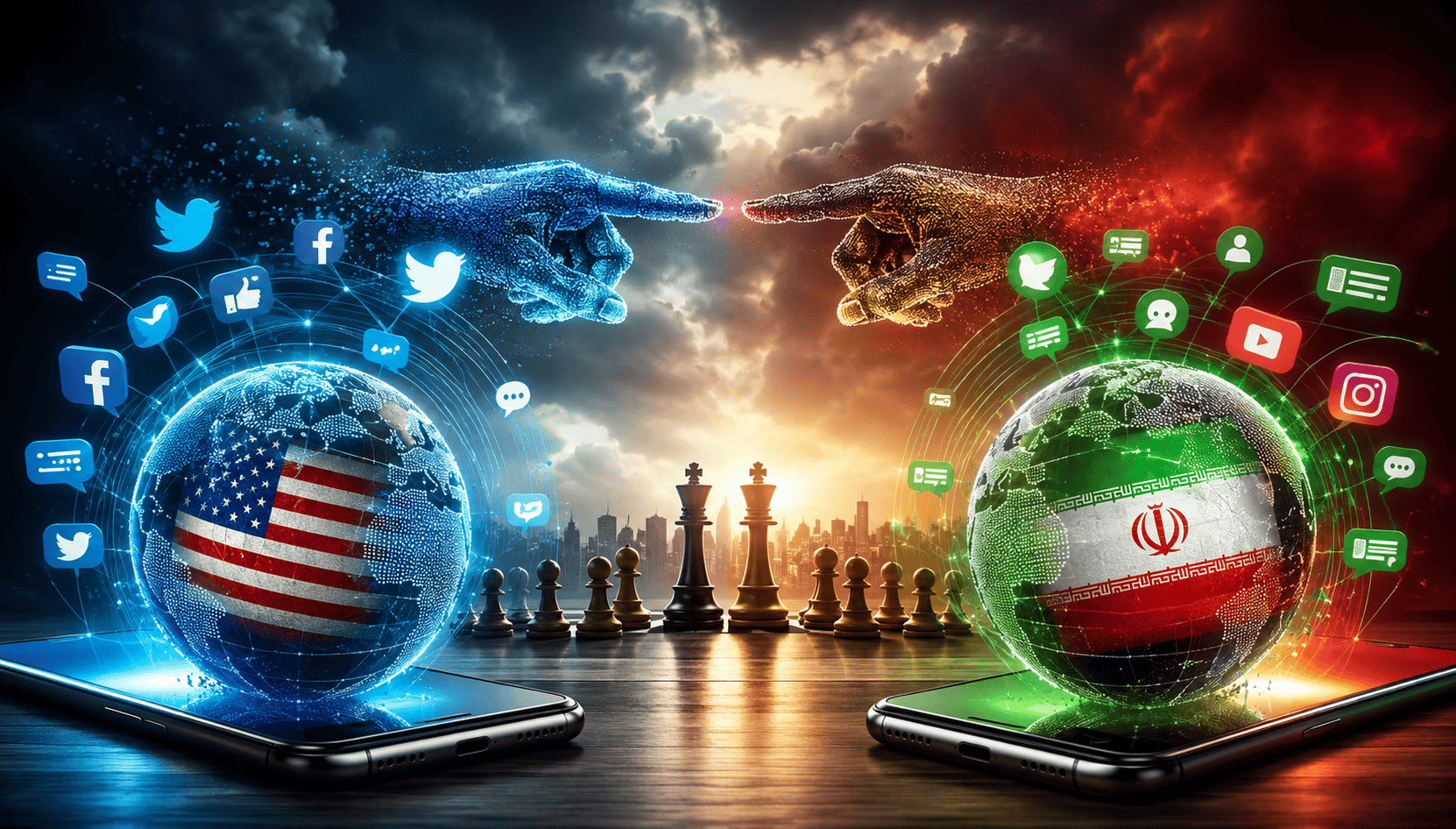
In the contemporary geopolitical landscape, communication through social media platforms acts as the space to construct the narrative of war and peace. However, existing literature failed to address how the adversarial political actors utilize social media to construct their favorable narratives. This study examines the digital media posts of U.S. representative, Trump, from Truth Social and two Iranian representatives, Araghchi and Baqaei, from X to investigate the shift in strategic use of linguistic feature to frame “us vs them” ideology and “war” and “peace” narratives across three phases: pre-peace talks (3–9 April), during peace talks (10–12 April), and post-peace talks (13–19 April). This study employs Fairclough's three-dimensional model as the primary framework to analyze the discourse at the micro level through textual analysis and integrates van Dijk's ideological Square and Chilton's Deictic Space Theory (DST) at this level. At the macro level, it explores the broader discursive and social practices in the discourse. The posts are selected using purposive sampling to compare ideological framing of power, military dominance, legitimacy, resistance, and national identity. The findings of the study reveal that political actors of both states maintain “us vs them” dichotomy through ideological polarization, strategic semantic fields, and deictic positioning. Moreover, the embedded discourse of peace through the competing ideologies of hegemony and sovereignty reflects that in modern geopolitical crisis, the linguistic features of diplomatic relations function not only as conflict resolution but also as a source of maintaining power and ideological dominance. The finding of this study which sets it apart from the previous researches is the emergence of temporal compression theme. US representative uses language to compress time, transforming it into combat instrument to coerce inter-state conflict.
Downloads
References
Ahmad, Y., Nazim, M., & Nijabat, A. (2025). Framing power and conflict: A critical discourse analysis of Donald Trump’s posts on the Iran-Israel war. Journal of Applied Linguistics and TESOL (JALT), 8(3), 1256–1264. https://doi.org/10.63878/jalt1105
Aljoundi, B. A. K. (2024). A comparative discourse analysis of the lexical and ideological variations in the 2023 Palestinian-Israeli conflict [Master’s thesis, Hebron University]. Hebron University Institutional Repository. https://dspace.hebron.edu/jspui/bitstream/123456789/1490/1/A%20comparative%20discourse%20analysis%20of%20the%20lexical%20and%20ideological%20variations%20in%20the%202023%20Palestinia.pdf
Amer, M. (2017). Critical discourse analysis of war reporting in the international press: The case of the Gaza war of 2008–2009. Palgrave Communications, 3(1), 1–13. https://doi.org/10.1057/s41599-017-0015-2
Awad, A. L., Abdul-Hassan, Z. T., & Mohsin, F. M. (2026). A critical discourse analysis of military power manifestation in Donald Trump’s post-operation speeches. GAS Journal of Arts Humanities and Social Sciences (GASJAHSS), 4(4), 17–24. https://doi.org/10.5281/zenodo.19355301
Bibi, Z., Khan, M. H., Qias, M., & Hayat, Q. (2025). Strategic persuasion and public opinion shaping: A critical discourse analysis of Donald Trump’s rhetoric on the US-Iran conflict. Advance Social Science Archive Journal, 3(2), 2228–2238. https://assajournal.com/index.php/36/article/view/499
Brusylovska, O., & Maksymenko, I. (2023). Analysis of the media discourse on the 2022 war in Ukraine: The case of Russia. Regional Science Policy & Practice, 15(1), 222–236. https://doi.org/10.1111/rsp3.12579
Chadwick, A. (2017). The hybrid media system: Politics and power (2nd ed.). Oxford University Press.
Chilton, P. (2014). Language, space and mind: The conceptual geometry of linguistic meaning. Cambridge University Press.
Duncombe, C. (2017). Twitter and transformative diplomacy: Social media and Iran–US relations. International Affairs, 93(3), 545–562. https://doi.org/10.1093/ia/iix048
Fairclough, N. (1992a). Discourse and social change. Polity Press.
Hussain, N. (2015). US-Iran relations: Issues, challenges and prospects. Policy Perspectives, 12(2), 29–47. https://doi.org/10.13169/polipers.12.2.0029
Ismail, K. B. K., Ammar, H. M., Baloch, H. A., Khan, F. U., & Ullah, H. (2026). Language framing of the US–Israel–Iran conflict in international news headlines: A critical discourse analysis. The Critical Review of Social Sciences Studies, 4(1), 4246–4256. https://doi.org/10.59075/xm4pg460
Kvernbekk, T., & Bøe-Hansen, O. (2017). How to win wars: The role of the war narrative. In P. Olmos (Ed.), Narration as argument (pp. 215–234). Springer. https://doi.org/10.1007/978-3-319-56883-6_12
Lundgren, M., Svensson, I., & Karakus, D. C. (2023). Local ceasefires and de-escalation: Evidence from the Syrian civil war. Journal of Conflict Resolution, 67(7–8), 1350–1375. https://doi.org/10.1177/00220027221148655
Nigatu, B. A. (2023). War on paper: A critical discourse analysis of war reporting in Ethiopia. Heliyon, 9(7), Article e17857. https://doi.org/10.1016/j.heliyon.2023.e17857
Putri, N. S., Rizaldi, F., Simatupang, F. A., Nailah, I. A., & Natsir, M. (2026). Critical discourse analysis of international media framing of the Iran–United States conflict. International Journal of Education and Literature, 5(1), 180–188. https://doi.org/10.55606/ijel.v5i1.362
Saleem, M., Tan, D., Ali, S., & Al Mamun, A. (2025). Geopolitical uncertainty and firm default risk: The role of firm internationalization, political exposure, and industry affiliation. SSRN Electronic Journal. https://doi.org/10.2139/ssrn.5714495
van Dijk, T. A. (1993a). Principles of critical discourse analysis. Discourse & Society, 4(2), 249–283. https://doi.org/10.1177/0957926593004002006
van Dijk, T. A. (2005). War rhetoric of a little ally: Political implicatures and Aznar’s legitimatization of the war in Iraq. Journal of Language and Politics, 4(1), 65–91. https://doi.org/10.1075/jlp.4.1.04dij
Downloads
Published
Issue
Section
License
Copyright (c) 2026 Eeman Khalid, Zoneera Arshad, Maria Fatima Dogar (Corresponding author) (Author)

This work is licensed under a Creative Commons Attribution 4.0 International License.
Authors retain the copyright and full publishing rights of their work. All articles published in Scholar Insight Journal are licensed under the Creative Commons Attribution 4.0 International License (CC BY 4.0).
Under this license, readers are permitted to read, download, copy, distribute, print, search, link to the full texts, and reuse the published articles for any lawful purpose, including adaptation and commercial use, provided that appropriate credit is given to the original author(s), the source of publication, and the license terms are properly acknowledged.
The journal retains the right of first publication while authors maintain ownership of their intellectual property rights without restrictions.