
Lived Experiences of Psychological Despair among War Victims in Pakistan: A Qualitative Study
DOI:
https://doi.org/10.68024/apz4yw55Keywords:
Psychological despair, Hopelessness, War victims, Ex-FATA, Interpretative Phenomenological AnalysisAbstract
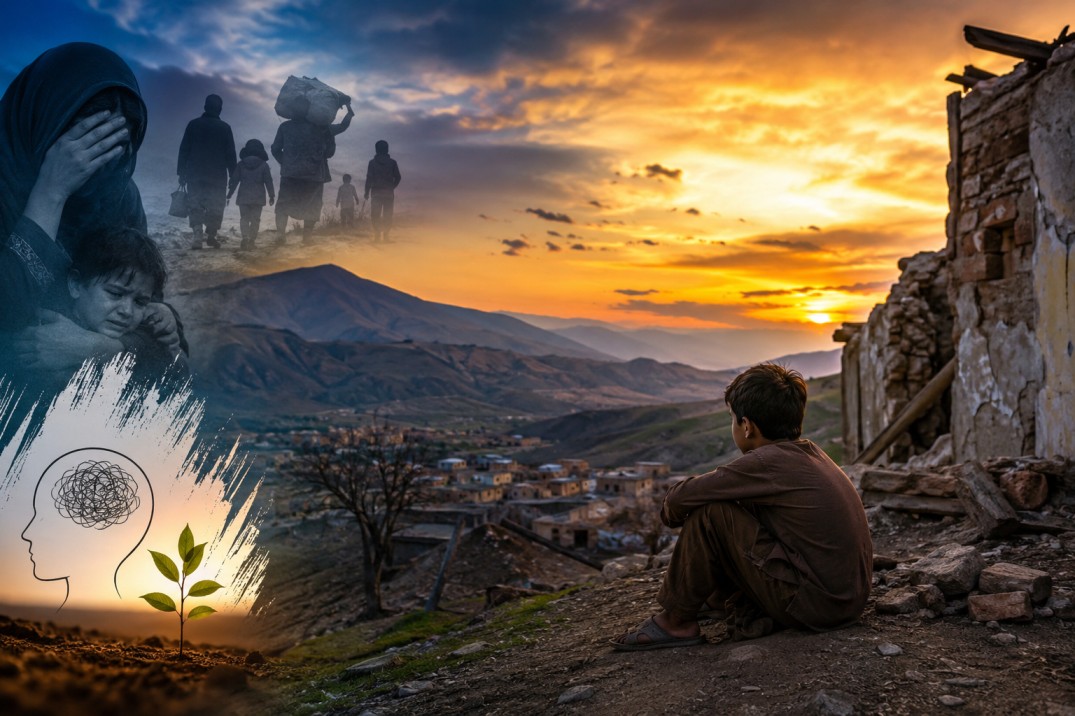
Present study aims to ascertain the lived experience of psychological despair among people from the Ex-FATA region of Pakistan affected by extended conflict and displacement. A purposive sample of 12 individuals (6 males and 6 females) age ranges 25–35 (M = 27.8, SD = 2.16) participated in semi-structured interviews. Interpretative Phenomenological Analysis (IPA) was used to analyse the participants’ data. IPA revealed four superordinate themes from participants’ data such as Pervasive Experiences of Hopelessness and Psychological Defeat, Living under Chronic Uncertainty and Instability, Despair Arising from Broken Hopes and Perceived Neglect, and Enduring and Adapting to Prolonged Adversity. Results indicate that despair in war victims is a multidimensional and dynamic psychological progression, including emotional hopelessness, existential insecurity, disappointment with institutional support, and adaptive strategies such as habituation, tolerance, and nostalgic meaning making. Resilience among individuals seemed to contain continuous functioning alongside enduring despair, rather than reflecting the absence of suffering. These results indicate the need for clinical interventions that directly deal with hopelessness, together with structural improvements ensuring consistent humanitarian support, for populations affected by persistent conflict.
Downloads
References
1. Alamgir, A., Kyriakides, C., Johnson, A., Abeshu, G., Bahri, B., & Abssy, M. (2024). Resilience mechanisms and coping strategies for forcibly displaced youth: An exploratory rapid review. International Journal of Environmental Research and Public Health, 21(10), 1347. https://doi.org/10.3390/ijerph21101347
2. Baig, K., Shahid, M., Akhtar, R., & Jamshed, J. (2024). Internally displaced persons: Rights, implementation, and the way forward in Pakistan. Current Trends in Law and Society, 4(1), 1–10. https://doi.org/10.52131/ctls.2023.0401.0027
3. Brugger, C., Hamad, B. A., Hattendorf, J., Winkler, M. S., & Probst-Hensch, N. (2025). Changes in psychological distress during conflict escalation in an adult population-based cohort in the Gaza Strip (2020–2025): A longitudinal analysis. EClinicalMedicine, 90, 103647. https://doi.org/10.1016/j.eclinm.2025.103647
4. Cantor, D., Swartz, J., Roberts, B., Abbara, A., Ager, A., Bhutta, Z. A., Blanchet, K., Bunte, D. M., Chukwuorji, J. C., Daoud, N., Ekezie, W., Jimenez-Damary, C., Jobanputra, K., Makhashvili, N., Rayes, D., Restrepo-Espinosa, M. H., Rodriguez-Morales, A. J., Salami, B., & Smith, J. (2021). Understanding the health needs of internally displaced persons: A scoping review. Journal of Migration and Health, 4, 100071. https://doi.org/10.1016/j.jmh.2021.100071
5. Cikuru, J., Kaganda, P., Blavier, A., & Foucart, J. (2025). Understanding psychotrauma in Sub-Saharan Africa: A scoping review of clinical and sociocultural perspectives. Frontiers in Psychology, 16, 1606131. https://doi.org/10.3389/fpsyg.2025.1606131
6. Dahal, N., Neupane, B. P., Pant, B. P., Dhakal, R. K., Giri, D. R., Ghimire, P. R., & Bhandari, L. P. (2024). Participant selection procedures in qualitative research: Experiences and some points for consideration. Frontiers in Research Metrics and Analytics, 9, 1512747. https://doi.org/10.3389/frma.2024.1512747
7. Fayyaz, R., & Chitrali, J. A. (2025). Post-conflict recovery and rehabilitation: An alternative psycho-social approach. Zenodo. https://doi.org/10.5281/zenodo.15358681
8. Hall, J., & Werner, K. (2022). Trauma and trust: How war exposure shapes social and institutional trust among refugees. Frontiers in Psychology, 13, 786838. https://doi.org/10.3389/fpsyg.2022.786838
9. Han, H., & Midorikawa, A. (2024). Depression accompanied by hopelessness is associated with more negative future thinking. Healthcare, 12(12), 1208. https://doi.org/10.3390/healthcare12121208
10. Hyland, P., Vallières, F., Shevlin, M., Karatzias, T., Ben-Ezra, M., McElroy, E., Vang, M. L., Lorberg, B., & Martsenkovskyi, D. (2023). Psychological consequences of war in Ukraine: Assessing changes in mental health among Ukrainian parents. Psychological Medicine, 53(15), 7466–7468. https://doi.org/10.1017/S0033291723000818
11. Kienzler, H., Massazza, A., Kuykendall, R., Tamimi, N., Hammoudeh, W., & Giacaman, R. (2024). Uncertainty and mental health: A qualitative scoping review. SSM - Qualitative Research in Health, 7, 100521. https://doi.org/10.1016/j.ssmqr.2024.100521
12. Pretorius, T. B., & Padmanabhanunni, A. (2024). A unidimensional short form of the Beck Hopelessness Scale (BHS-7) derived using item response theory. Scientific Reports, 14(1), 6021. https://doi.org/10.1038/s41598-024-56792-x
13. Smith, J. A., Flowers, P., & Larkin, M. (2022). Interpretative phenomenological analysis: Theory, method and research. SAGE Publications.
14. Tafet, G. E., & Alonso, T. O. (2025). Learned helplessness and learned controllability: From neurobiology to cognitive, emotional and behavioral neurosciences. Frontiers in Psychiatry, 16, 1600165. https://doi.org/10.3389/fpsyt.2025.1600165
15. Tesfai, A., Captari, L. E., Meyer-Weitz, A., & Cowden, R. G. (2023). Coping resources among forced migrants in South Africa: Exploring the role of character strengths in coping, adjustment, and flourishing. International Journal of Environmental Research and Public Health, 21(1), 50. https://doi.org/10.3390/ijerph21010050
Downloads
Published
Issue
Section
License
Copyright (c) 2026 Sanam Khalid, Dr. Mahwesh Arooj Naz (Author)

This work is licensed under a Creative Commons Attribution 4.0 International License.
Authors retain the copyright and full publishing rights of their work. All articles published in Scholar Insight Journal are licensed under the Creative Commons Attribution 4.0 International License (CC BY 4.0).
Under this license, readers are permitted to read, download, copy, distribute, print, search, link to the full texts, and reuse the published articles for any lawful purpose, including adaptation and commercial use, provided that appropriate credit is given to the original author(s), the source of publication, and the license terms are properly acknowledged.
The journal retains the right of first publication while authors maintain ownership of their intellectual property rights without restrictions.