Hybrid English In Pakistani Advertisements: A World Englishes Perspective
DOI:
https://doi.org/10.68024/nvqwv060Keywords:
Hybrid English, Ads, National Language, NativisationAbstract
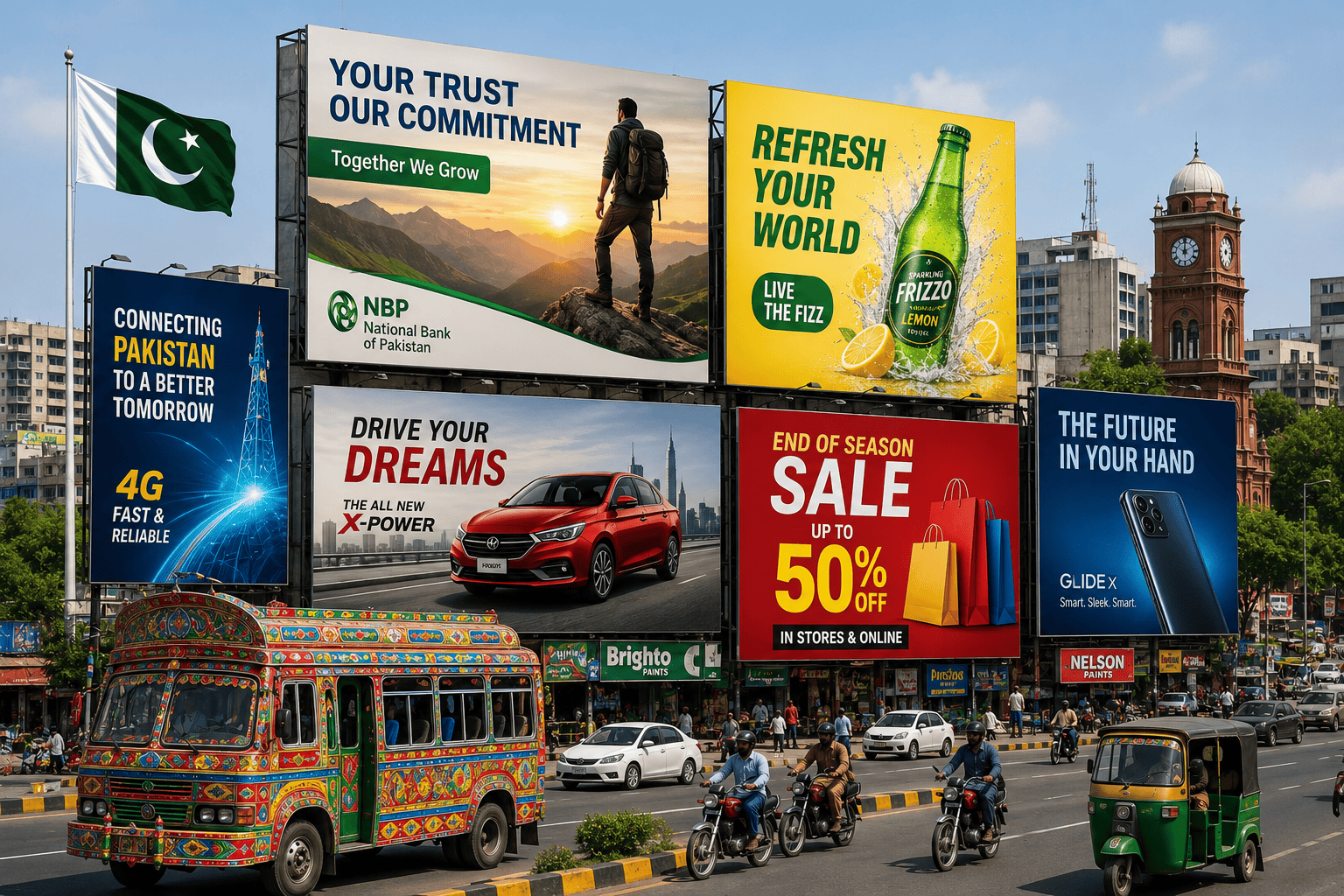
This paper explores the sociolinguistics of hybrid English of Pakistan's advertising from the perspective of ‘World Englishes’, to see how English is synthesized with Urdu and Roman Urdu in the commercial language. The Pakistani ads are culturally diverse, where bilingual/hybrid language is used strategically to cater to the local audience without compromising the response of the global audience. The Urdu language is rendered onto English by creating localized versions of language which are meaningful and convincing, as Urdu is spoken as the national language and English is a prestigious language around the globe. This paper uses a discourse-stylistic analysis of products based on a qualitative research design on advertisements of products such as banks, beauty, food, clothes and health. The data indicate that the systematic use of hybrid English is used to project modernity, cultural identity, and to elicit audiences' responses while the process of nativisation and the formation of local norms are witnessed. At the end, it is concluded that advertising is a great influential place where Pakistani English is evoked and normalized as a part of World Englishes.
Downloads
References
Akinyi, C. A. (2017). An analysis of language use in billboard advertisements in Kisumu County, Kenya [Master’s thesis, University of Nairobi].
de Silva, L. I. (2014). The status of English as a prestige language in post-colonial educational frameworks. Sri Lanka Journal of Humanities, 40(1), 45–58. https://doi.org/10.4038/sljh.v40i1.7241
Dyer, G. (1982). Advertising as communication. Routledge.
Kachru, B. B. (1985). Standards, codification and sociolinguistic realism: The English language in the Outer Circle. In R. Quirk & H. G. Widdowson (Eds.), English in the world: Teaching and learning the language and literatures (pp. 11–30). Cambridge University Press.
Kelly-Holmes, H. (2005). Advertising as multilingual communication. Palgrave Macmillan. https://doi.org/10.1057/9780230503014
Khan, M., Shah, M., Jang, A., Hamid, A., & Shams, S. A. (2020). Language hybridization in advertisements of banks in Pakistan. European Online Journal of Natural and Social Sciences, 9(2), 443–454.
Riaz, M. (2019). Language variation: Code-mixing and code-switching in Pakistani commercials. Journal of Language and Linguistic Studies, 15(2), 411–419. https://doi.org/10.17263/jlls.586085
Sultana, K. (2014). Hybrid language and constructions of modernity in Pakistani advertising discourse [Doctoral dissertation, University of Auckland]. ResearchSpace@Auckland. https://researchspace.auckland.ac.nz/handle/2292/22352
Tina, A. A. (2014). Bengali-English code-switching in commercial signboards in Bangladesh. In Proceedings of the 12th Asia TEFL and 23rd MELTA International Conference (pp. 106–113).
Trudgill, P. (2000). Sociolinguistics: An introduction to language and society (4th ed.). Penguin Books.
Ullah, Z., Alam, M. F., & Javed, I. (2022). The portrayal of cross-cultural aspects in digital toothpaste advertisements: A semiotic study. Pakistan Social Sciences Review, 6(2), 733–749. https://doi.org/10.35484/pssr.2022(6-II)61
Waseem, M., Shah, T. A., & Hussain, A. (2020). Anglicization of Urdu language: A lexico-grammatical analysis of Urdu advertisements. Pakistan Social Sciences Review, 4(3), 656–667. https://doi.org/10.35484/pssr.2020(4-III)46
Zhiganova, A. V. (2016). The study of the perception of code-switching to English in German advertising. Procedia - Social and Behavioral Sciences, 236, 225–229. https://doi.org/10.1016/j.sbspro.2016.12.011
Downloads
Published
Issue
Section
License
Copyright (c) 2026 Ayesha Sajid, Dr. Sadia Waheed (Author)

This work is licensed under a Creative Commons Attribution 4.0 International License.
Authors retain the copyright and full publishing rights of their work. All articles published in Scholar Insight Journal are licensed under the Creative Commons Attribution 4.0 International License (CC BY 4.0).
Under this license, readers are permitted to read, download, copy, distribute, print, search, link to the full texts, and reuse the published articles for any lawful purpose, including adaptation and commercial use, provided that appropriate credit is given to the original author(s), the source of publication, and the license terms are properly acknowledged.
The journal retains the right of first publication while authors maintain ownership of their intellectual property rights without restrictions.