
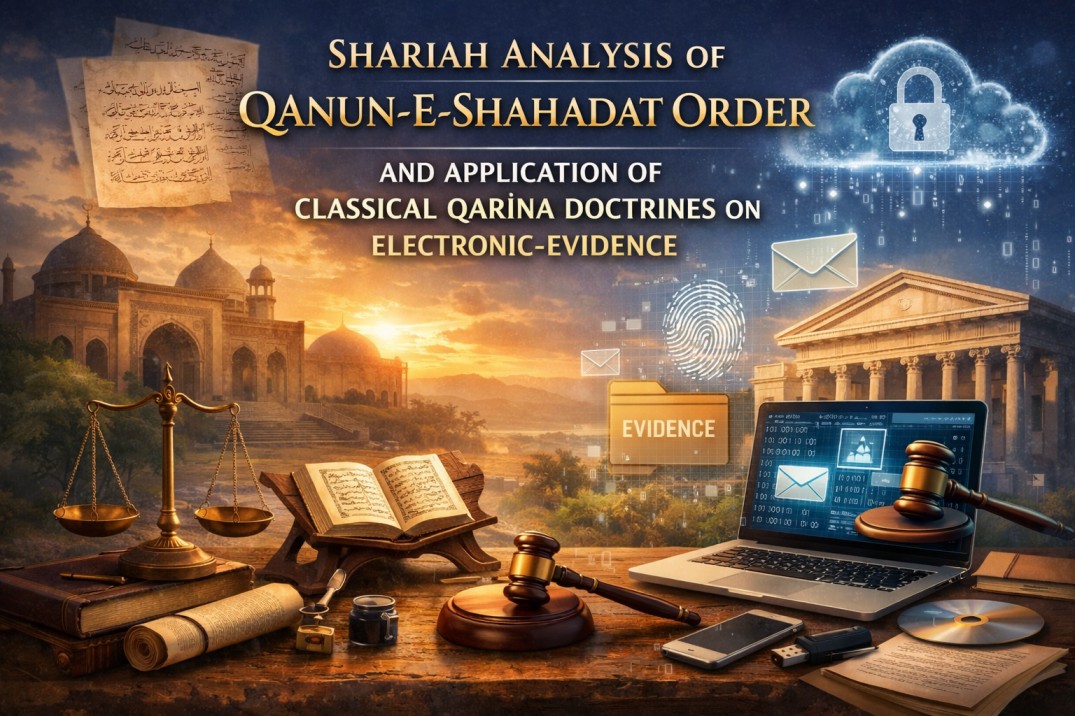
SHARIAH ANALYSIS OF QANUN-E-SHAHADAT ORDER AND APPLICATION OF CLASSICAL QARĪNA DOCTRINES ON ELECTRONIC-EVIDENCE
DOI:
https://doi.org/10.68024/2byyja55Keywords:
Qanun-e-Shahadat Order, Shariah-compliant evidence, Classical Qarīna, Islamic jurisprudenceAbstract
The advent of digital technology has transformed the evidentiary landscape, presenting unique challenges for legal systems grounded in classical doctrines. This article undertakes a Shariah-based analysis of Pakistan’s Qanun-e-Shahadat Order (QSO), 1984, with particular focus on its treatment of electronic evidence. It examines how traditional Islamic principles of proof, especially the classical doctrine of Qarīna (presumptions and inferential evidence), can inform the admissibility, credibility, and weight of electronic records such as emails, digital contracts, and forensic data. By juxtaposing the QSO provisions with classical qarīna concepts, the study identifies convergences and gaps, highlighting areas where contemporary judicial practice may benefit from Shariah-guided reasoning. The article also discusses methodological challenges in interpreting electronic evidence under both statutory and Shariah frameworks, emphasizing principles such as certainty (yaqin), corroboration, and avoidance of unjust assumptions. Through case law analysis and doctrinal comparison, it proposes a harmonized approach that respects the integrity of Islamic evidentiary standards while addressing the technical complexities of digital proof. The findings underscore the potential for classical qarīna doctrines to enrich modern evidentiary evaluation, ensuring justice, reliability, and fairness in the digital age.
Downloads
References
1.Al-‘Amrī, Ṣ. b. Muḥammad. (n.d.). Iqāẓ himam ūlī al-abṣār li’l-iqtiḍā’ bi-sayyid al-muhājirīn wa’l-anṣār. Beirut: Dār al-Ma‘rifah li’l-Ṭibā‘ah wa’l-Nashr.
2.Al-’Atāsī, M. K. (1985). Sharḥ Majallat al-aḥkām al-‘adliyyah (Vols. 1–5). Quetta: Maktabah Islāmiyyah.
3.Alfaize, N. A. (2015). The impact of culture and religion on digital forensics: The study of the role of digital evidence in the legal process in Saudi Arabia (Doctoral dissertation, De Montfort University, Leicester).
4.Al-Qurṭubī, A. ‘U. Y. b. ‘Abd Allāh. (1980). Al-kāfī fī fiqh ahl al-Madīnah (Vols. 1–2). Riyadh: Maktabat al-Riyadh al-Ḥadīthah.
5.Al-Rāzī, F. al-D. M. b. ‘U. (1420 AH). Mafātīḥ al-ghayb (al-tafsīr al-kabīr) (Vols. 1–18). Beirut: Dār Iḥyā’ al-Turāth al-‘Arabī. Retrieved from www.altafsir.com
6.Al-Sarkhasī, S. al-D. M. b. A. (1998). Al-mabsūṭ (Vols. 1–30). Beirut: Dār al-Ma‘rifah.
7.Al-Shāfi‘ī, A. Ḥ. Y. b. ‘A. al-K. al-‘Imrānī. (2000). Al-bayān fī madhhab al-imām al-Shāfi‘ī (Vols. 1–13). Jeddah: Dār al-Minhāj.
8.Al-Shīrāzī, A. Y. (n.d.). Al-muhadhdhab fī fiqh al-imām al-Shāfi‘ī (Vols. 1–3). Beirut: Dār al-Kitāb al-‘Ilmiyyah.
9.Al-Zuḥaylī, W. (1985). Al-fiqh al-islāmī wa adillatuh (Vols. 1–10). Damascus: Dār al-Fikr.
10.Badā’i‘ al-Ṣanā’i‘ fī tartīb al-sharā’i‘. (1998). Al-Kāsānī, ‘A. al-D. A. B. b. M. (2nd ed., Vols. 1–7). Beirut: Dār al-Kutub al-‘Ilmiyyah.
11.Davidson, A. (2009). The law of electronic commerce. New Delhi: Cambridge University Press.
12.Daniel, L., & Daniel, L. (2012). Digital forensics for legal professionals: Understanding digital evidence from warrant to courtroom. Waltham, MA: Elsevier.
13.Delaney, H., & Francis, B. (2015). Is your use of electronic signatures protecting your interests? Governance Directions, 67(8), 479–482.
14.Duranti, L., Rogers, C., & Sheppard, A. (2010). Electronic records and the law of evidence in Canada: The uniform electronic evidence act twelve years later. Archivaria, 70, 95–124.
15.Favro, P. J. (2007). A new frontier in electronic discovery: Preserving and obtaining metadata. Boston University Journal of Science & Technology Law, 13(1), 1–25. https://ssrn.com/abstract=2255160
16.Finkelstein, S. M., & Storch, E. R. (2010). Admissibility of electronically stored information: It’s still the same old story. Journal of the American Academy of Matrimonial Lawyers, 23, 45–72.
17.Fredesvinda, I. (2007). The admissibility of electronic evidence in court: Fighting against high-tech crime. Journal of Digital Forensic Practice, 1(4), 285–289. https://doi.org/10.1080/15567280701418049
18.Goodison, S. E., Davis, R. C., & Jackson, B. A. (2015). Digital evidence and the U.S. criminal justice system. Santa Monica, CA: RAND Corporation.
19.Haneef, S. S. S. (2006). Modern means of proof: Legal basis for its accommodation in Islamic law. Arab Law Quarterly, 20(4), 334–364.
20.Ingram, J. L. (2015). Criminal evidence (12th ed.). Waltham, MA: Anderson Publishing.
21.Ibn ‘Ābidīn, M. A. b. ‘U. (1992). Radd al-muḥtār ‘alā al-durr al-mukhtār (Vols. 1–6). Beirut: Dār al-Fikr.
22.Ibn Nujaīm, Z. al-D. b. I. (n.d.). Al-baḥr al-rā’iq sharḥ Kanz al-daqā’iq (Vols. 1–8). Beirut: Dār al-Kitāb al-Islāmī.
23.Ibn Qayyim al-Jawziyyah, M. b. A. B. (1953). Al-ṭuruq al-ḥukmiyyah fī al-siyāsah al-shar‘iyyah. Cairo: Dār al-Madanī.
24.Ibn Rushd, M. b. A. (2004). Bidāyat al-mujtahid wa nihāyat al-muqtaṣid (Vols. 1–4). Cairo: Dār al-Ḥadīth.
25.Ibn Taymiyyah, T. al-D. A. b. ‘A. (1995). Majmū‘ al-fatāwā (Vols. 1–35). Madinah: Majma‘ al-Malik Fahd.
26.Kerr, O. S. (2005). Digital evidence and the new criminal procedure. Columbia Law Review, 105, 279–318.
27.Keane, A., & McKeown, P. (2014). The modern law of evidence. Oxford: Oxford University Press.
28.Mālik b. Anas. (2004). Al-Muwaṭṭa’ (Vols. 1–6). Abu Dhabi: Mu’assasat Zāyid b. Sulṭān.
29.Muslim b. al-Ḥajjāj. (n.d.). Ṣaḥīḥ Muslim. Beirut: Dār Iḥyā’ al-Turāth al-‘Arabī.
30.Seng, D. K. B. (1997). Computer output as evidence. Singapore Journal of Legal Studies, 159–166.
Downloads
Published
Issue
Section
License
Copyright (c) 2025 Hafsa Abbasi (Author)

This work is licensed under a Creative Commons Attribution 4.0 International License.
Authors retain the copyright and full publishing rights of their work. All articles published in Scholar Insight Journal are licensed under the Creative Commons Attribution 4.0 International License (CC BY 4.0).
Under this license, readers are permitted to read, download, copy, distribute, print, search, link to the full texts, and reuse the published articles for any lawful purpose, including adaptation and commercial use, provided that appropriate credit is given to the original author(s), the source of publication, and the license terms are properly acknowledged.
The journal retains the right of first publication while authors maintain ownership of their intellectual property rights without restrictions.