
Exchange Rate Volatility and Foreign Direct Investment under Democracy and Diplomatic Governance of Pakistan
DOI:
https://doi.org/10.68024/6fe4rh42Keywords:
Exchange rate volatility, foreign direct investment, Political regimesAbstract
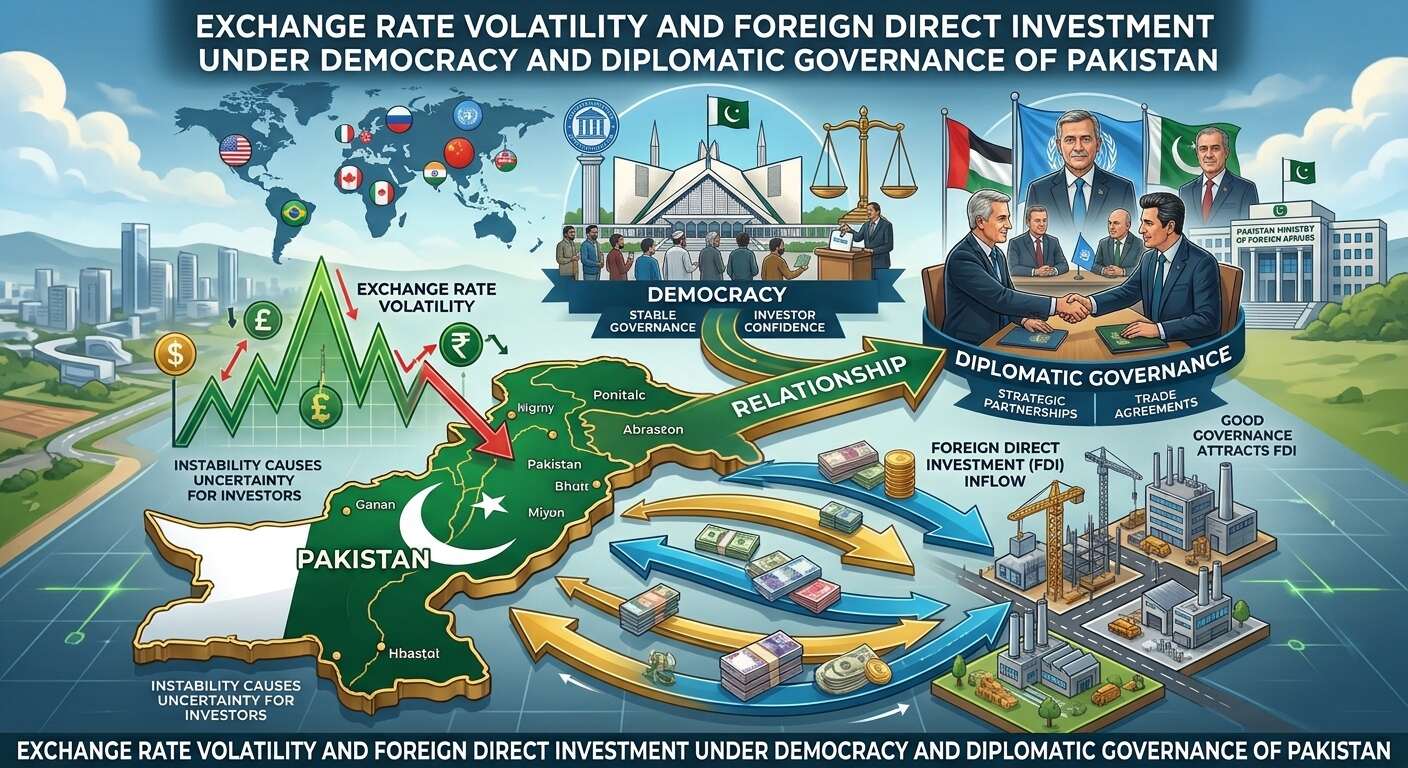
This study examines the relationship between exchange rate volatility and foreign direct investment (FDI) in Pakistan, paying particular attention to how this relationship differs under democratic versus military governance. Using annual data spanning 1973–2020 (with regression estimation drawing on the 1990–2019 WDI sample), the study first generates a volatility series for the exchange rate using a GARCH(1,1) model, then applies the Autoregressive Distributed Lag (ARDL) approach to estimate both long-run and short-run effects on FDI, controlling for GDP, inflation, and trade openness. The GARCH results show that exchange rate volatility is highly persistent, with shocks decaying slowly over time. The ARDL bounds test confirms a long-run relationship among the variables in both models estimated. In the baseline model, exchange rate volatility is found to exert a significant negative effect on FDI, while currency depreciation and trade openness have significant positive effects; these relationships hold in the long run but disappear in the short run, where coefficients are statistically insignificant. When a political regime dummy is introduced to distinguish democratic from military rule, exchange rate volatility continues to depress FDI, but its coefficient becomes positive and loses statistical significance during democratic periods, suggesting that political regime moderates investor sensitivity to currency fluctuations. These findings indicate that exchange rate stability, rather than depreciation alone, is central to attracting foreign investment, and that the political environment shapes how investors respond to currency risk. The study recommends that Pakistani policymakers prioritize exchange rate stabilization and political continuity as complementary strategies for sustaining FDI inflows.
Downloads
References
Ahmed, A. (2018). Modelling the effect of stock market volatility and exchange rate volatility on foreign direct investment in Nigeria: A new framework approach. Asian Economic and Financial Review, 8(12), 1482–1505. https://doi.org/10.18488/journal.aefr.2018.812.1482.1505 DOI: https://doi.org/10.18488/journal.aefr.2018.812.1482.1505
Ali, S., & Guo, W. (2005). Determinants of FDI in China. Journal of Global Business and Technology, 1(2), 21–33.
Aliber, R. Z. (1970). A theory of direct foreign investment. In C. P. Kindleberger (Ed.), The international corporation (pp. 17–34). MIT Press.
Aqeel, A., Nishat, M., & Bilquees, F. (2004). The determinants of foreign direct investment in Pakistan. The Pakistan Development Review, 43(4), 651–664. https://doi.org/10.30541/v43i4pp.651-664 DOI: https://doi.org/10.30541/v43i4IIpp.651-664
Arratibel, O., Furceri, D., Martin, R., & Zdzienicka, A. (2011). The effect of nominal exchange rate volatility on real macroeconomic performance in the CEE countries. Economic Systems, 35(2), 261–277. https://doi.org/10.1016/j.ecosys.2010.11.006 DOI: https://doi.org/10.1016/j.ecosys.2010.05.003
Ashraf, S., & Nagia, R. (2021). The impact of relative exchange rate volatility and other multidimensional determinants on FDI in Egypt. American Journal of Industrial and Business Management, 11(12), 1163–1197. https://doi.org/10.4236/ajibm.2021.1112071 DOI: https://doi.org/10.4236/ajibm.2021.1112071
Asmae, A., & Ahmed, B. (2019). Impact of the exchange rate and price volatility on FDI inflows: Case of Morocco and Turkey. Applied Economics and Finance, 6(3), 87–104. https://doi.org/10.11114/aef.v6i3.4132 DOI: https://doi.org/10.11114/aef.v6i3.4218
Azhar, A., Ullah, N., & Malik, Q. A. (2015). Effect of exchange rate volatility on foreign direct investment in SAARC countries. Middle-East Journal of Scientific Research, 23(2), 350–356.
Boahen, E., & Evans, O. (2014). The effect of exchange rate volatility on foreign direct investment in Ghana. International Journal of Economic Behavior and Organization, 2(2), 20–28. DOI: https://doi.org/10.11648/j.ijebo.20140202.12
Brzozowski, M. (2006). Exchange rate variability and foreign direct investment: Consequences of EMU enlargement. Eastern European Economics, 44(1), 5–24. https://doi.org/10.2753/EEE0012-8775440101 DOI: https://doi.org/10.2753/EEE0012-8755440101
Chowdhury, A., & Mavrotas, G. (2006). FDI and growth: What causes what? The World Economy, 29(1), 9–19. https://doi.org/10.1111/j.1467-9701.2006.00755.x DOI: https://doi.org/10.1111/j.1467-9701.2006.00755.x
Chowdhury, A. R., & Wheeler, M. (2008). Does real exchange rate volatility affect foreign direct investment? Evidence from four developed economies. The International Trade Journal, 22(2), 218–245. https://doi.org/10.1080/08853900801987080 DOI: https://doi.org/10.1080/08853900801970601
Dal Bianco, S., & Loan, N. C. T. (2017). FDI inflows, price and exchange rate volatility: New empirical evidence from Latin America. International Journal of Financial Studies, 5(1), Article 6. https://doi.org/10.3390/ijfs5010006 DOI: https://doi.org/10.3390/ijfs5010006
Dhakal, D., Nag, R., Pradhan, G., & Upadhyaya, K. P. (2010). Exchange rate volatility and foreign direct investment: Evidence from East Asian countries. International Business & Economics Research Journal, 9(7), 121–128. DOI: https://doi.org/10.19030/iber.v9i7.603
Durairaj, K., & Nirmala, V. (2012). Do exchange rate and its volatility deter foreign direct investment (FDI) to India? The Indian Economic Journal, 60(1), 130–144. https://doi.org/10.1177/0001924020120108 DOI: https://doi.org/10.1177/0019466220120108
Elly, O. D., & Ojung’a, A. S. (2015). The effect of exchange rate volatility on foreign direct investments in Kenya. International Journal of Education and Research, 1(9), 1–8.
Engle, R. F. (1982). Autoregressive conditional heteroscedasticity with estimates of the variance of United Kingdom inflation. Econometrica, 50(4), 987–1007. https://doi.org/10.2307/1912773 DOI: https://doi.org/10.2307/1912773
Engle, R. F., & Granger, C. W. (1987). Co-integration and error correction: Representation, estimation, and testing. Econometrica, 55(2), 251–276. https://doi.org/10.2307/1913236 DOI: https://doi.org/10.2307/1913236
Froot, K. A., & Stein, J. C. (1991). Exchange rates and foreign direct investment: An imperfect capital markets approach. The Quarterly Journal of Economics, 106(4), 1191–1217. https://doi.org/10.2307/2937958 DOI: https://doi.org/10.2307/2937961
Furceri, D., & Borelli, S. (2008). Foreign direct investments and exchange rate volatility in the EMU neighborhood countries. Journal of International and Global Economic Studies, 1(1), 42–59.
Goldberg, L. S., & Kolstad, C. D. (1995). Foreign direct investment, exchange rate variability and demand uncertainty. International Economic Review, 36(4), 855–873. https://doi.org/10.2307/2527265 DOI: https://doi.org/10.2307/2527262
Görg, H., & Wakelin, K. (2002). The impact of exchange rate volatility on US direct investment. The Manchester School, 70(3), 380–397. https://doi.org/10.1111/1467-9957.00305 DOI: https://doi.org/10.1111/1467-9957.00308
Havi, E. D. K. (2021). The impact of exchange rate volatility on foreign direct investment inflows in Ghana. African Journal of Economic Review, 9(4), 183–199.
Hniya, S., Boubker, A., Mrad, F., & Nafti, S. (2021). The impact of real exchange rate volatility on foreign direct investment inflows in Tunisia. International Journal of Economics and Financial Issues, 11(5), 52–60. https://doi.org/10.32479/ijefi.11663 DOI: https://doi.org/10.32479/ijefi.11882
Jadhav, P. (2012). Determinants of foreign direct investment in BRICS economies: Analysis of economic, institutional and political factor. Procedia - Social and Behavioral Sciences, 37, 5–14. https://doi.org/10.1016/j.sbspro.2012.03.270 DOI: https://doi.org/10.1016/j.sbspro.2012.03.270
Kiliçarslan, Z. (2018). The relationship between exchange rate volatility and foreign direct investment in Turkey: Toda and Yamamoto causality analysis. International Journal of Economics and Financial Issues, 8(4), 61–67.
Kiyota, K., & Urata, S. (2004). Exchange rate, exchange rate volatility and foreign direct investment. The World Economy, 27(10), 1501–1536. https://doi.org/10.1111/j.1467-9701.2004.00664.x DOI: https://doi.org/10.1111/j.1467-9701.2004.00664.x
Kyereboah-Coleman, A., & Agyire-Tettey, K. F. (2008). Effect of exchange-rate volatility on foreign direct investment in Sub-Saharan Africa: The case of Ghana. The Journal of Risk Finance, 9(1), 52–70. https://doi.org/10.1108/15265940810842410 DOI: https://doi.org/10.1108/15265940810842410
Mahjoub, E. (2014). Impact of exchange rate volatility on macroeconomic performance in Sudan. Journal of Development and Economic Policies, 16(1), 73–105.
Mahmood, I., Ehsanullah, M., & Habib, A. (2011). Exchange rate volatility & macroeconomic variables in Pakistan. Business Management Dynamics, 1(2), 11–22.
Martins, J. F. S. (2015). Impact of real exchange rate volatility on foreign direct investment inflows in Brazil [Master's thesis, Fundação Getulio Vargas]. FGV Repository.
Moraghen, W., Seetanah, B., & Sookia, N. (2021). Impact of exchange rate and exchange rate volatility on foreign direct investment inflow for Mauritius: A dynamic time series approach. African Development Review, 33(4), 581–591. https://doi.org/10.1111/1467-8268.12602 DOI: https://doi.org/10.1111/1467-8268.12596
Muhammad, S. D., Azu, N. P., & Oko, N. F. (2018). Influence of real exchange rate and volatility on FDI inflow in Nigeria. International Business Research, 11(6), 73–82. https://doi.org/10.5539/ibr.v11n6p73 DOI: https://doi.org/10.5539/ibr.v11n6p73
Obwona, M. B. (2001). Determinants of FDI and their impact on economic growth in Uganda. African Development Review, 13(1), 46–81. https://doi.org/10.1111/1467-8268.00030 DOI: https://doi.org/10.1111/1467-8268.00030
Osinubi, T. S., & Amaghionyeodiwe, L. A. (2009). Foreign direct investment and exchange rate volatility in Nigeria. International Journal of Applied Econometrics and Quantitative Studies, 6(2), 83–116.
Qin, J. (2000). Exchange rate risk and two-way foreign direct investment. International Journal of Finance & Economics, 5(3), 221–231. https://doi.org/10.1002/1099-1158(200007)5:3<221::AID-IJFE128>3.0.CO;2-P DOI: https://doi.org/10.1002/1099-1158(200007)5:3<221::AID-IJFE126>3.0.CO;2-J
Ramzan, M. (2021). Symmetric impact of exchange rate volatility on foreign direct investment in Pakistan: Do the global financial crises and political regimes matter? Annals of Financial Economics, 16(4), Article 2250007. https://doi.org/10.1142/S20104952250007X DOI: https://doi.org/10.1142/S2010495222500075
Sharifi-Renani, H., & Mirfatah, M. (2012). The impact of exchange rate volatility on foreign direct investment in Iran. Procedia Economics and Finance, 1, 365–373. https://doi.org/10.1016/S2212-5671(12)00042-1 DOI: https://doi.org/10.1016/S2212-5671(12)00042-1
Udoh, E., & Egwaikhide, F. O. (2008). Exchange rate volatility, inflation uncertainty and foreign direct investment in Nigeria. Botswana Journal of Economics, 5(7), 14–31. DOI: https://doi.org/10.4314/boje.v5i7.60304
Ullah Khan, U., Sultan, F., & Rehman, Z. U. (2017). An analysis of exchange rate volatility and FDI inflow in Pakistan using ARDL bound testing technique (1981–2015). International Journal of Applied Research, 5(5), 1–9.
Ullah, S., Haider, S. Z., & Azim, P. (2012). Impact of exchange rate volatility on foreign direct investment: A case study of Pakistan. Pakistan Economic and Social Review, 50(2), 121–138.
United Nations Conference on Trade and Development. (2022). World investment report 2022: International tax reforms and sustainable investment. United Nations.
Wang, D. (2013). The impact of exchange rate volatility on foreign direct investment (FDI) in BRIC countries [Master's thesis, University of Nottingham].
Yonghui, H., Minghui, H., & Ziwen, L. (2020). Dynamic impact of RMB exchange rate on FDI and OFDI: An empirical analysis based on the ternary GARCH model. Management Review, 32(9), 34–45.
Zakari, M. (2017). The impact of exchange rate fluctuations on foreign direct investment in Nigeria. Journal of Finance and Accounting, 5(4), 165–170. https://doi.org/10.11648/j.jfa.20170504.17 DOI: https://doi.org/10.11648/j.jfa.20170504.17
Downloads
Published
Issue
Section
License
Copyright (c) 2024 Kashfa Anwar, Kamran Abbas Haider, Benish Batool (Author)

This work is licensed under a Creative Commons Attribution 4.0 International License.
Authors retain the copyright and full publishing rights of their work. All articles published in Scholar Insight Journal are licensed under the Creative Commons Attribution 4.0 International License (CC BY 4.0).
Under this license, readers are permitted to read, download, copy, distribute, print, search, link to the full texts, and reuse the published articles for any lawful purpose, including adaptation and commercial use, provided that appropriate credit is given to the original author(s), the source of publication, and the license terms are properly acknowledged.
The journal retains the right of first publication while authors maintain ownership of their intellectual property rights without restrictions.