
Exploring The Drivers of Social Media Marketing in Pakistan’s Perspective
DOI:
https://doi.org/10.68024/cf0jq596Keywords:
Hedonic motivation, interactivity, perceived expectancy, perceived usefulness, purchase intention, social media marketingAbstract
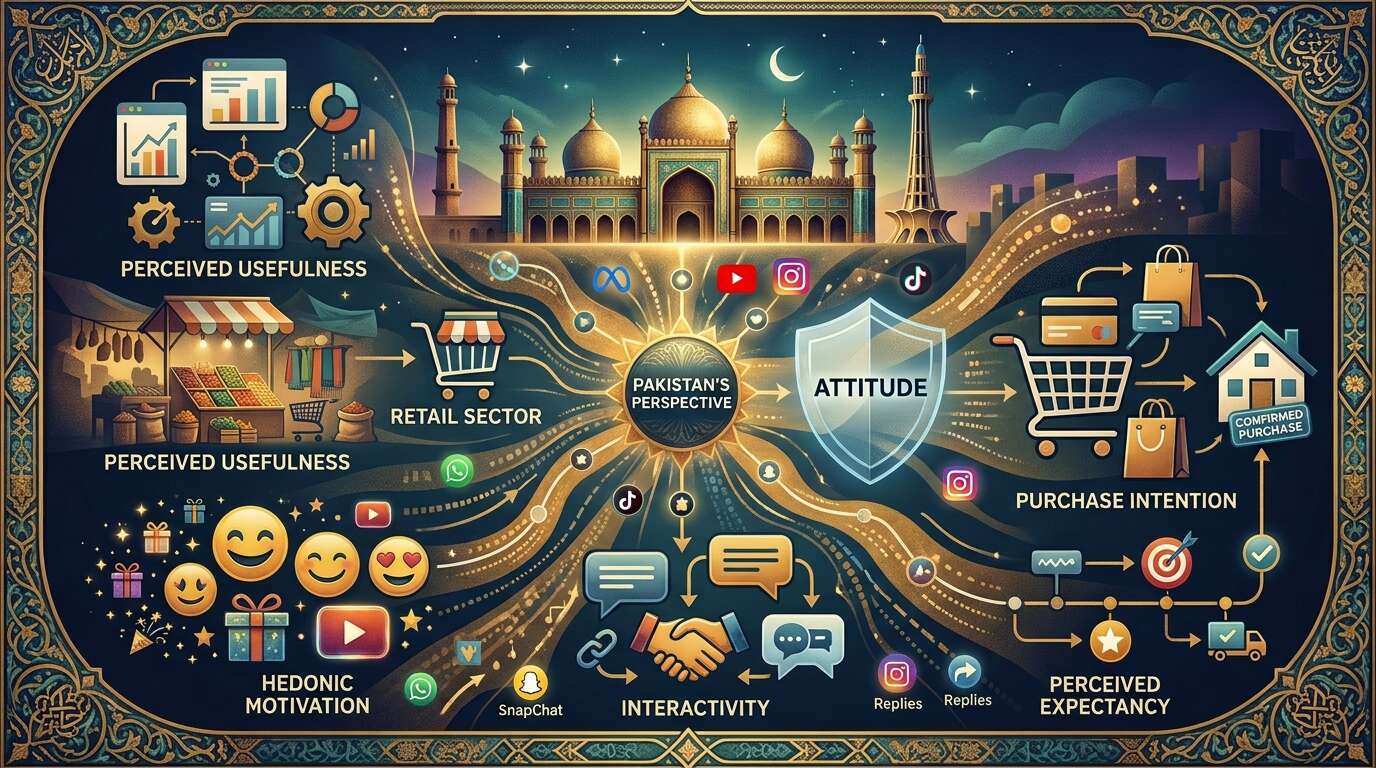
Social media marketing is essential for business influencing consumer attitudes and purchase intentions. (18 words) The study aims to examine the antecedents social media marketing activities in retail sector of Pakistan . Perceived usefulness, hedonic motivation, interactivity and perceived expectancy. Based on the Theory of Planned Behavior, it is proposed that social media usage attitude are shaped by these four factors; and attitude are associated with purchase intention. Using a structured questionnaire and five-point Likert scale will collect responses from social media users in Pakistan a cross-sectional survey design will be used. The recommended analysis will include descriptive statistics, reliability and validity checks, structural model testing, and bootstrapping to examine the mediating role of attitude. Social media platform-specific evaluations of marketing susceptibility are hypothesized to be positively influenced by consumers’ information value, enjoyment, interactive communication, and expected benefits. It seems that consumer attitudes may also link social media marketing experiences with purchase intention. As the numbers in the next analysis are simulated, they do not constitute empirical results, and the proposed relationship must be tested with real survey data. According to the study, a framework is provided for future investigations. Likewise, it can help retailers recognize features to investigate when developing consumer-oriented social media marketing strategies in Pakistan.
Downloads
References
Aji, P., Nadhila, V., & Sanny, L. (2020). Effect of social media marketing on Instagram towards purchase intention: Evidence from Indonesia’s ready-to-drink tea industry. International Journal of Data and Network Science, 4(2), 91–104. DOI: https://doi.org/10.5267/j.ijdns.2020.3.002
Ajzen, I. (1991). The theory of planned behavior. Organizational Behavior and Human Decision Processes, 50(2), 179–211. DOI: https://doi.org/10.1016/0749-5978(91)90020-T
Ceyhan, A. (2019). The impact of perception related social media marketing applications on consumers’ brand loyalty and purchase intention. EMAJ: Emerging Markets Journal, 9(1), 88–100. DOI: https://doi.org/10.5195/emaj.2019.173
Chen, S. C., & Lin, C. P. (2019). Understanding the effect of social media marketing activities: The mediation of social identification, perceived value, and satisfaction. Technological Forecasting and Social Change, 140, 22–32. DOI: https://doi.org/10.1016/j.techfore.2018.11.025
Ebrahim, R. S. (2020). The role of trust in understanding the impact of social media marketing on brand equity and brand loyalty. Journal of Relationship Marketing, 19(4), 287–308. DOI: https://doi.org/10.1080/15332667.2019.1705742
Hajdúc, Z., & Balogh, P. (2025). Relationship between social media marketing and young customers’ purchase intention towards online shopping. Cogent Business & Management. https://doi.org/10.1080/23311886.2025.2459881 DOI: https://doi.org/10.1080/23311886.2025.2459881
Hu, S., & Zhu, Z. (2022). Effects of social media usage on consumers’ purchase intention in social commerce: A cross-cultural empirical analysis. Frontiers in Psychology, 13, Article 837752. https://doi.org/10.3389/fpsyg.2022.837752 DOI: https://doi.org/10.3389/fpsyg.2022.837752
Huang, Y., Bunchapattanasakda, C., Suo, L., & Boonmek, B. (2024). The influence of social media marketing on purchase intentions through consumer engagement. Asian Administration and Management Review, 7(2), 45–55. https://doi.org/10.14456/aamr.2024.21
Jamil, K., Dunnan, L., Gul, R. F., Shehzad, M. U., Gillani, S. H. M., & Awan, F. H. (2022). Role of social media marketing activities in influencing customer intentions: A perspective of a new emerging era. Frontiers in Psychology, 12, Article 808525. https://doi.org/10.3389/fpsyg.2021.808525 DOI: https://doi.org/10.3389/fpsyg.2021.808525
Kannan, P. K. (2017). Digital marketing: A framework, review and research agenda. International Journal of Research in Marketing, 34(1), 22–45. DOI: https://doi.org/10.1016/j.ijresmar.2016.11.006
Khattak, M. A. R., Ali, M. D., & Khan, S. (2024). Exploring the impact of social media marketing on customer purchase intentions: The moderating roles of social forces. International Journal of Business and Economic Affairs, 9(3), 81–92. https://doi.org/10.24088/IJBEA-2024-930010
Kumaran, K., Lunyai, J., & Ahmad Nordin, N. B. (2024). The role of hedonic motivation in social commerce toward consumer purchase intention. International Journal of Business and Society. https://doi.org/10.33736/ijbs.7619.2024 DOI: https://doi.org/10.33736/ijbs.7619.2024
Liu, P., & Qureshi, H. A. (2023). The effects of social media marketing on customer’s purchase intention: A moderated mediation model from apparel industry of Pakistan. International Journal of Business and Economics Research, 12(3), 115–122. https://doi.org/10.11648/j.ijber.20231203.15 DOI: https://doi.org/10.11648/j.ijber.20231203.15
Malik, I. A., Raza, M. A., Hadi, N. U., Khan, M. J., & Hameed, F. (2023). Social commerce constructs and purchase intention on social commerce sites: Investigating the role of affective and cognitive attitudes in managing digital marketing challenges. Management & Marketing, 18(Suppl. 1), 474–495. https://doi.org/10.2478/mmcks-2023-0026 DOI: https://doi.org/10.2478/mmcks-2023-0026
McClure, C., & Seock, Y. K. (2020). The role of involvement: Investigating the effect of brand’s social media pages on consumer purchase intention. Journal of Retailing and Consumer Services, 53, Article 101975. DOI: https://doi.org/10.1016/j.jretconser.2019.101975
Pasha, S. U. U., Siddiqui, M. S., Ali, R., Kamal, M. H., & Khan, A. R. (2024). Social network marketing and the consumer purchase intention: Mediation role of brand trust and brand image. Journal of Asian Development Studies, 13(2), 1961–1971. https://doi.org/10.62345/jads.2024.13.2.153 DOI: https://doi.org/10.62345/jads.2024.13.2.153
Saura, J. R., Palos-Sanchez, P. R., & Correia, M. B. (2019). Digital marketing strategies based on the e-business model: Literature review and future directions. In Organizational transformation and managing innovation in the Fourth Industrial Revolution (pp. 86–103). IGI Global. DOI: https://doi.org/10.4018/978-1-5225-7074-5.ch005
Selem, K. M., Shoukat, M. H., Shah, S. A., et al. (2023). The dual effect of digital communication reinforcement drivers on purchase intention in the social commerce environment. Humanities and Social Sciences Communications, 10, Article 47. https://doi.org/10.1057/s41599-023-01539-8 DOI: https://doi.org/10.1057/s41599-023-01539-8
Tariq, S., Tariq, A., Raweem, A., Tahira, H., Amjad, J., & Nauman, K. (2023). Impact of social media advertisement on customer purchase intention: A sequential mediation analysis. Abasyn Journal of Social Sciences, 16(1). https://doi.org/10.34091/AJSS.16.1.04
Waheed Khan, S., & Adnan, M. (2023). The effect of social media usage and advertising on consumers’ purchase intention in Pakistan. NUST Business Review. https://doi.org/10.37435/NBR22051601 DOI: https://doi.org/10.37435/NBR22051601
Downloads
Published
Issue
Section
License
Copyright (c) 2026 Yaseen Aslam Khattak (Author)

This work is licensed under a Creative Commons Attribution 4.0 International License.
Authors retain the copyright and full publishing rights of their work. All articles published in Scholar Insight Journal are licensed under the Creative Commons Attribution 4.0 International License (CC BY 4.0).
Under this license, readers are permitted to read, download, copy, distribute, print, search, link to the full texts, and reuse the published articles for any lawful purpose, including adaptation and commercial use, provided that appropriate credit is given to the original author(s), the source of publication, and the license terms are properly acknowledged.
The journal retains the right of first publication while authors maintain ownership of their intellectual property rights without restrictions.