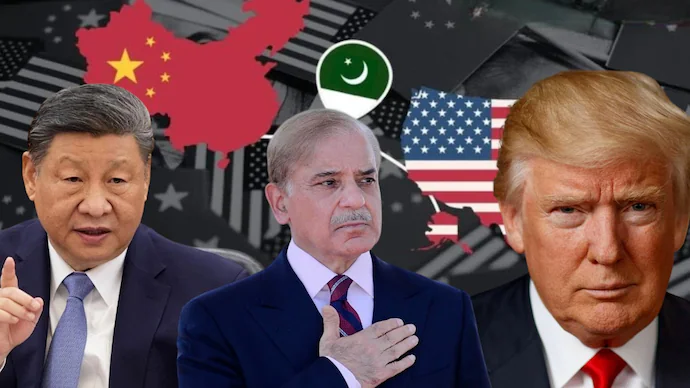
PAKISTAN AS THE PIVOT: REASSESSING SOUTH ASIAN BALANCE OF POWER IN THE US–CHINA RIVALRY
الكلمات المفتاحية:
Pakistan، South Asia، Balance of Power، US–China Rivalry، Hedging Strategy، Strategic Autonomy، CPEC، Regional Stabilityالملخص
In this article, Pakistan's role as a strategic pivot in the balance of power between the United States and China in South Asia is re-examined. Although the current literature tends to discuss South Asia in the context of either the India-China dyad or the Indo-Pacific strategy, this study is central to Pakistan's persistent geostrategic centrality. Using a combination of theoretical frameworks of realism and regional security complex theory, the article places Pakistan at the center of all of its state alignment decisions, impacting regional stability, global connectivity, and power projection. The sustainability of this study is premised on the U.S strategic repositioning, the Belt and Road Initiative, the China-Pakistan Economic Corridor (CPEC), and the hedging policy established in Pakistan, showing that Islamabad is not an inactive by-product of the great power game, or a peripheral player. Instead, it is Pakistan that is redefining South Asian geopolitics by reshaping its role to balance its economic and security needs. This article aims to provide policy suggestions for the Pakistani government to play a mediating role in establishing stability, capitalize on connectivity, and redefine its identity in the evolving multipolar world order.
التنزيلات
المراجع
1. Abbasi, Rizwana. “Global Power Shift and Foreign Policy Choices for Pakistan,” 2023. https://www.issi.org.pk/wpcontent/uploads/2023/08/Rizwana_Abbasi_SS_No_1_2023.pdf.
2. Ahmed, Waqas, Sharafat Ali, Muhammad Asghar, and Alisher Ismailov. “Assessment and Analysis of the Complexities in Sustainability of the Transport Projects under CPEC: A Grounded Theory Approach.” SAGE Open 13, no. 4 (October 1, 2023). https://doi.org/10.1177/21582440231203477.
3. Ali, Iftikhar, Noraiz Arshad, and Roy Anthony Rogers. “Trilateral Dynamics in Pakistan’s Foreign Policy: Balancing China and Hedging the US.” Strategic Analysis, December 31, 2024, 1–17. https://doi.org/10.1080/09700161.2024.2434382.
4. Anwar, Dr, Dr Ghulam, and Ahmed Hussain. “Pakistan’s Global Strategy: Navigating the US-China Tug-of-War.” 3, no. 02 (2025): 2038–50. https://www.assajournal.com/index.php/36/article/view/484.
5. Asad, Ali. “GEOPOLITICS of CONNECTIVITY among SUB-REGIONS of GREATER CENTRAL ASIA.” Metu.edu.tr. Middle East Technical University, 2025. https://open.metu.edu.tr/handle/11511/114953.
6. Asle Toje and Barbara Kunz. Neoclassical Realism in European Politics. Manchester University Press, 2024.
7. Bryman, Alan. “Integrating Quantitative and Qualitative Research: How Is It Done?” Qualitative Research 6, no. 1 (February 2006): 97–113. https://doi.org/10.1177/1468794106058877.
8. Bukhari, Ali. “South Asia’s Power Play: Pakistan, India, China, and the USA in Strategic Relations.” ` 4, no. 01 (2025): 111–22. https://www.assajournal.com/index.php/36/article/view/512.
9. BUZAN, BARRY, and OLE WÆVER. “Slippery? Contradictory? Sociologically Untenable? The Copenhagen School Replies.” Review of International Studies 23, no. 2 (April 1997): 241–50. https://doi.org/10.1017/s0260210597002416.
10. Buzan, Barry, and Ole Waever. “Regions and Powers the Structure of International Security.” Cambridge University Press, 2003. https://ir101.co.uk/wp-content/uploads/2018/11/Buzan-Waever-2003-Regions-and-Powers-The-Structure-of-International-Security.pdf.
11. Ch, Ali, Nadia Zaheer, None Salah Uddin, and None Zakar Hussain. “Pakistan’s Strategic Balancing Act: Navigating Relations between China, the US and the Emerging Multipolar World Order.” ˜the œCritical Review of Social Sciences Studies 3, no. 2 (April 19, 2025): 553–66. https://doi.org/10.59075/t3kkh396.
12. Chesebro, James W., and Deborah J. Borisoff. “What Makes Qualitative Research Qualitative?” Qualitative Research Reports in Communication 8, no. 1 (October 15, 2007): 3–14. https://doi.org/10.1080/17459430701617846.
13. Faisal, Muhammad. “RISE of MIDDLE POWERS in a MULTIPOLAR WORLD and ITS IMPACT on PAKISTAN.” Policy Research Journal 3, no. 9 (2025): 240–54. https://policyrj.com/index.php/1/article/view/1003.
14. Farooq, Irfan, and Dr Muhammad. “Pakistan’s Strategic Imperatives and Maritime Security Challenges in the Indian Ocean.” Journal of Nautical Eye and Strategic Studies 3, no. 2 (2023): 44–58. https://doi.org/10.58932/MULG0022.
15. Flechas Chaparro, Ximena Alejandra, and Leonardo Augusto de Vasconcelos Gomes. “Pivot Decisions in Startups: A Systematic Literature Review.” International Journal of Entrepreneurial Behavior & Research ahead-of-print, no. ahead-of-print (February 26, 2021). https://doi.org/10.1108/ijebr-12-2019-0699.
16. Gioia, Denny. “A Systematic Methodology for Doing Qualitative Research.” The Journal of Applied Behavioral Science 57, no. 1 (2021): 20–29. https://doi.org/10.1177/0021886320982715.
17. Gul, Hafsa, Imran Naseem, Muhammad Bahar Khan, and Khalid Zaman. “Assessing the Impact of U.S. Economic Aid and Military Support on the Strategic Dynamics of Pakistan’s Foreign Policy: A Study of Diplomatic Relations and Public Sentiment.” Future Business Journal 11, no. 1 (May 2, 2025). https://doi.org/10.1186/s43093-025-00528-4.
18. Jabr, Ferris. “John A. Long - Publications List.” Publicationslist.org 14, no. 6 (2023).
19. Khan, Dr Yunas, Saeedullah, and Fazli Rahman. “PAKISTAN’S NUCLEAR DIPLOMACY: BALANCING DETERRENCE and GLOBAL NON-PROLIFERATION NORMS.” ` 3, no. 01 (2025): 1225–43. https://assajournal.com/index.php/36/article/view/244.
20. Khan, Saeeda, Muhammad Waqas, and Khali Ur Rehman. “The BRI & the CPEC: An Economic & Strategic Reconfiguration.” The Lighthouse Journal of Social Sciences 4, no. 01 (2025): 13–26. https://kpheart.edu.pk/ojs/index.php/ljss/article/view/187.
21. Khan, Zafar. “The Effects of US–China Competing Strategies in Asia-Pacific on India and Pakistan Rivalry in the South Asian Region.” Asian Journal of Comparative Politics, July 1, 2021, 205789112110211. https://doi.org/10.1177/20578911211021155.
22. Khizar, Dr. Sundas . “Navigating US-South Asia Relations: Strategic Interests and Future Trajectories.” Pakistan Social Sciences Review 8, no. II (June 30, 2024). https://doi.org/10.35484/pssr.2024(8-ii)62.
23. Kuszewska, Agnieszka, and Agnieszka Nitza-Makowska. “Multifaceted Aspects of Economic Corridors in the Context of Regional Security: The China–Pakistan Economic Corridor as a Stabilising and Destabilising Factor.” Journal of Asian Security and International Affairs 8, no. 2 (June 2, 2021): 218–48. https://doi.org/10.1177/23477970211017719.
24. Lusenti, Arthur. “The Indo-Pakistani Conflict in Light of the ‘Islamic Bomb,’” 2025. https://www.gcsp.ch/sites/default/files/2025-06/GP-2025_36_Lusenti%3Bdigital.pdf.
25. Lynch, Thomas F. “The Inevitable U.S. Return and the Future of Great Power Competition in South Asia.” Digital Commons @ NDU, 2022. https://digitalcommons.ndu.edu/inss-strategic-perspectives/11/.
26. Maheen Shafeeq. “India’s Strategic Autonomy and the US-India Strategic Partnership: Implications on Pakistan.” Journal of Security & Strategic Analyses 11, no. 1 (July 1, 2025): 05-28. https://doi.org/10.57169/jssa.0011.01.0344.
27. Marston, Hunter S. “Navigating Great Power Competition: A Neoclassical Realist View of Hedging.” International Relations of the Asia-Pacific 24, no. 1 (February 16, 2023). https://doi.org/10.1093/irap/lcad001.
28. Mcsweeney, Bill. “Identity and Security: Buzan and the Copenhagen School.” Review of International Studies 22, no. 1 (January 1, 1996): 81–93. https://doi.org/10.1017/s0260210500118467.
29. Ms. Noor-e-Hera, Mr. Nosherwan Adil, Dr. Muhammad Saeed Uzzaman. “PAKISTAN’S QUEST for STRATEGIC AUTONOMY: HEDGING against US-CHINA-RUSSIA RIVALRIES POST2013.” Pakistan Journal of International Affairs 7, no. 2 (June 20, 2024). https://doi.org/10.52337/pjia.v7i2.1082.
30. Muhammad Ghaffar, and Prof. Dr. Muhammad Khan. “CPEC: A SOURCE of STRENGTHENING BILATERAL TIES and DRIVING STRATEGIC PARTNERSHIP.” Pakistan Journal of International Affairs 7, no. 3 (September 20, 2024). https://doi.org/10.52337/pjia.v7i3.1119.
31. Muhammad, Dr, Dr Humera Akhtar, and Dr Ibrar Hussain. “The China Factor in Pakistan’s Middle East Diplomacy: A Shift from Religious Solidarity to Strategic Realism.” ` 3, no. 02 (2025): 1220–29. https://www.assajournal.com/index.php/36/article/view/415.
32. object Object. “PAKISTAN’S SECURITY DILEMMA in the ERA of GREAT POWER COMPETITION.” Core.ac.uk, 2024. oai:calhoun.nps.edu:10945/72599.
33. Oktay Kucukdegirmenci. “Theoretical Framework: Balance of Power and Types of Balancing Acts.” Springer.com, January 1, 2024, 27–50. https://doi.org/10.1007/978-981-97-7578-1_2.
34. Rabbi, Fazal, Mahar Munawar, and Syed Hamid Mehmood Bukhari. “DONALD TRUMP’S POLICY and POSTURE towards PAKISTAN: THE EMERGING DYNAMICS and DRIVERS of the BILATERAL TIES.” Pakistan Journal of Social Research 04, no. 02 (June 30, 2022): 194–207. https://doi.org/10.52567/pjsr.v4i2.467.
35. Ramos, David. “Strategic Competition and Regional Recalibration: South Asia in the Shadow of United States–China Rivalry.” Journal of Policy Options 8, no. 2 (2025): 1–8. https://doi.org/10.5281/zenodo.15769973.
36. Rasool, Maimoona. “Impact of Shifting China-U.S. Strategic Dynamics on Pakistan’s Geopolitical Positioning.” Research Journal Al-Qanṭara, 2024, 247–70. https://alqantarajournal.com/index.php/Journal/article/view/585.
37. Rasool, Memoona, and Ayesha Bhatti. “The Pakistan-Russia Strategic Alliance: A New Geopolitical Paradigm in South Asia Introduction Theoretical...” ResearchGate. unknown, November 2023. https://www.researchgate.net/profile/Gul-Bhatti/publication/380890722_The_Pakistan-Russia_strategic_alliance_a_new_geopolitical_paradigm_in_south_Asia_Introduction_Theoretical_Descriptions_Geopolitical_Prospect_of_South_Asia_Pak-Russia_Defence_Relations_Pak-Russia.
38. Steff, Reuben. “Theoretical Framework: Geopolitical Realism and Great Power Competition.” Global Political Transitions, January 1, 2024, 15–59. https://doi.org/10.1007/978-981-96-0282-7_2.
39. Tahir, Muhammad, and Mehwish Rasheed. “Geo Economic Significance of Pakistan: A Strategic Nexus for Regional and Global Dynamic.” Khaldunia-Journal of Social Sciences 4, no. 1 (2024): 27–39. https://doi.org/10.36755/.
40. Turhan, Nihan Sölpük. “QUALITATIVE RESEARCH DESIGNS: WHICH ONE IS the BEST for YOUR RESEARCH?” European Journal of Special Education Research 4, no. 2 (May 30, 2019). https://doi.org/10.46827/ejse.v0i0.2448.
41. Ullah, Asad, and Li Xinlei. “Navigating the Persian Gulf Security Complex: Saudi-Iran Rapprochement in an Era of Great Power Competition.” East Asia 41 (July 24, 2024): 273–300. https://doi.org/10.1007/s12140-024-09430-2.
42. Wæver, Ole. “Towards a Political Sociology of Security Studies.” Security Dialogue 41, no. 6 (December 2010): 649–58. https://doi.org/10.1177/0967010610388213.
43. Zaidi, Syed Muhammad Saad, and Nirmal. “Regional Political Paradigm Shift: Challenges and Opportunities for Pakistan.” Asian Journal of Comparative Politics 7, no. 4 (June 16, 2022): 772–89. https://doi.org/10.1177/20578911221103358.
التنزيلات
منشور
إصدار
القسم
الرخصة
الحقوق الفكرية (c) 2026 Scholar Insight Journal

هذا العمل مرخص بموجب Creative Commons Attribution 4.0 International License.
Authors retain the copyright of their work. All articles in Scholar Insight Journal are published under the terms of the Creative Commons Attribution 4.0 International License (CC BY 4.0).
This license permits anyone to read, download, copy, distribute, print, search, or link to the full texts of the articles, and to use them for any other lawful purpose, without asking prior permission from the author(s) or the publisher, provided proper attribution is given to the original work.