
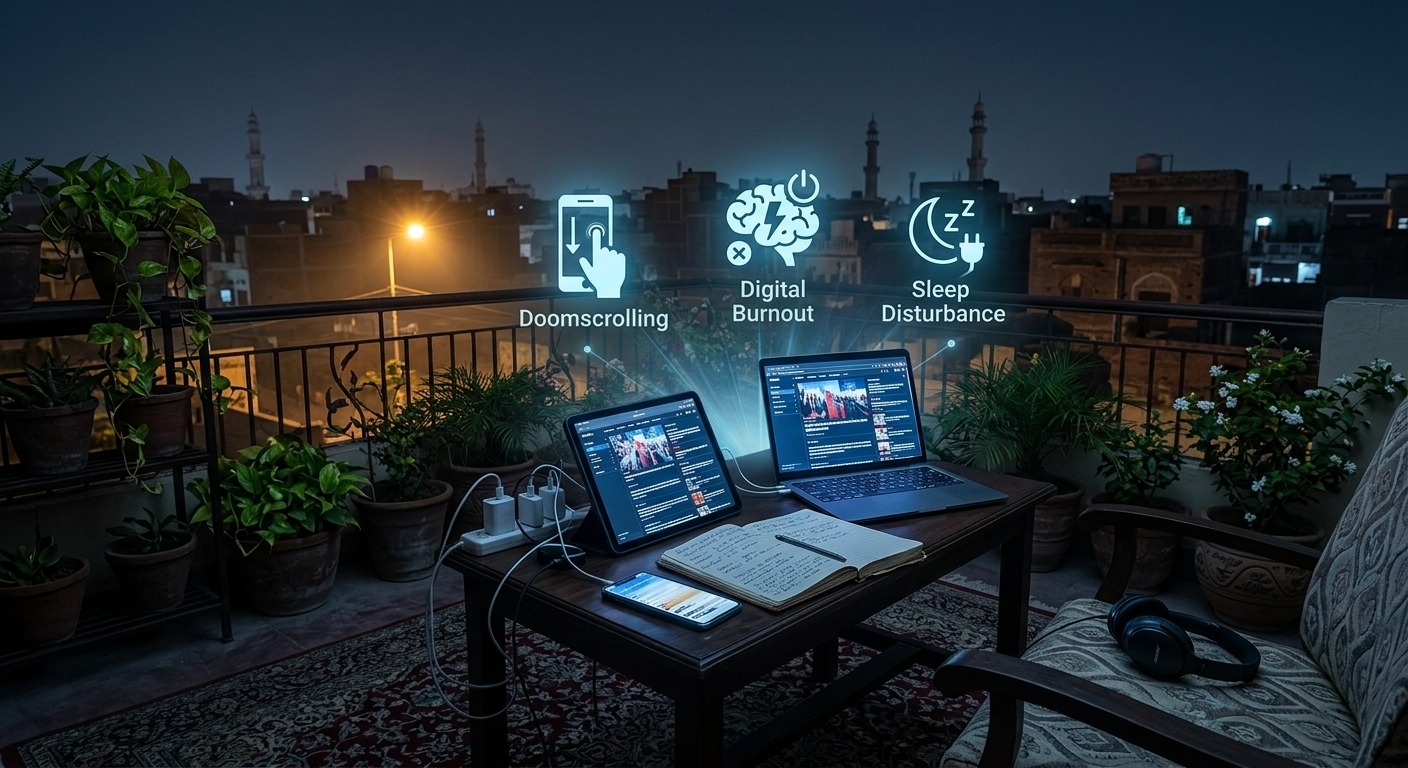
Doomscrolling, Digital Burnout, and Sleep Disturbance Among University Students in Pakistan: The Statistical Mediating Role of Digital Burnout
##semicolon##
https://doi.org/10.68024/wswsvn55##semicolon##
doomscrolling##common.commaListSeparator## digital burnout##common.commaListSeparator## sleep disturbance##common.commaListSeparator## university students##article.abstract##
Doomscrolling the repetitive consumption of negative online information has been associated with psychological distress, yet the processes linking this behaviour with sleep problems remain insufficiently studied in Pakistani university populations. This cross sectional quantitative study examined the associations among doomscrolling, digital burnout, and sleep disturbance and tested whether digital burnout statistically accounted for part of the doomscrolling sleep relationship. The cleaned sample comprised 300 university students aged 18 29 years; Pittsburgh Sleep Quality Index (PSQI) scores were derivable for 283 participants. Doomscrolling was measured using the 11 items available from the exported Doomscrolling Questionnaire, digital burnout using 23 available items from the Digital Burnout Scale, and sleep disturbance using the PSQI. Doomscrolling correlated strongly with digital burnout, r = .710, p < .001, and positively with sleep disturbance, r = .606, p < .001. Digital burnout also correlated with sleep disturbance, r = .580, p < .001. A bootstrap mediation model showed a significant indirect association through digital burnout, ab = .033, 95% BCa CI [.016, .051], while the direct effect remained significant. Poor sleep quality (PSQI > 5) was observed in 65.7% of participants with scoreable PSQI data. The findings support digital burnout as a plausible, nonexclusive statistical pathway connecting doomscrolling with poorer sleep, while the cross sectional design precludes causal inference.
##plugins.themes.default.displayStats.downloads##
##submission.citations##
Alonzo, R., Hussain, J., Stranges, S., & Anderson, K. K. (2021). Interplay between social media use, sleep quality, and mental health in youth: A systematic review. Sleep Medicine Reviews, 56, Article 101414. https://doi.org/10.1016/j.smrv.2020.101414
Ayyagari, R., Grover, V., & Purvis, R. (2011). Technostress: Technological antecedents and implications. MIS Quarterly, 35(4), 831 858. https://doi.org/10.2307/41409963
Bauducco, S., Pillion, M., Bartel, K., Reynolds, C., Kahn, M., & Gradisar, M. (2024). A bidirectional model of sleep and technology use: A theoretical review of how much, for whom, and which mechanisms. Sleep Medicine Reviews, 76, Article 101933. https://doi.org/10.1016/j.smrv.2024.101933
Buysse, D. J., Reynolds, C. F., Monk, T. H., Berman, S. R., & Kupfer, D. J. (1989). The Pittsburgh Sleep Quality Index: A new instrument for psychiatric practice and research. Psychiatry Research, 28(2), 193 213. https://doi.org/10.1016/0165 1781(89)90047 4
Camadan, F., & Uzunoğlu, O. (2026). The role of FoMO and nomophobia in explaining the relationship between doomscrolling and poor sleep quality. BMC Psychology, 14, Article 115. https://doi.org/10.1186/s40359 025 03865 9
Carter, B., Rees, P., Hale, L., Bhattacharjee, D., & Paradkar, M. S. (2016). Association between portable screen based media device access or use and sleep outcomes: A systematic review and meta analysis. JAMA Pediatrics, 170(12), 1202 1208. https://doi.org/10.1001/jamapediatrics.2016.2341
Chkhaidze, A., Millar, B. M., Revenson, T. A., & Mindlis, I. (2025). Scrolling your sleep away: The effects of bedtime device use on sleep among young adults with poor sleep. International Journal of Behavioral Medicine, 32(4), 634 639. https://doi.org/10.1007/s12529 024 10326 x
Choi, S. Y., & Kim, J. H. (2024). Validity and reliability of the Korean version of the Digital Burnout Scale. Frontiers in Public Health, 12, Article 1386394. https://doi.org/10.3389/fpubh.2024.1386394
Creswell, J. W., & Creswell, J. D. (2018). Research design: Qualitative, quantitative, and mixed methods approaches (5th ed.). SAGE.
Erten, P., & Özdemir, O. (2020). The Digital Burnout Scale. İnönü University Journal of the Faculty of Education, 21(2), 668 683. https://doi.org/10.17679/inuefd.597890
Field, A. (2018). Discovering statistics using IBM SPSS Statistics (5th ed.). SAGE.
Göldağ, B. (2022). An investigation of the relationship between university students’ digital burnout levels and perceived stress levels. Journal of Learning and Teaching in Digital Age, 7(1), 90 98. https://doi.org/10.53850/joltida.958039
Hartstein, L. E., Mathew, G. M., Reichenberger, D. A., Rodriguez, I., Allen, N., Chang, A. M., Chaput, J. P., Christakis, D. A., Garrison, M., Gooley, J. J., Koos, J. A., Van Den Bulck, J., Woods, H., Zeitzer, J. M., Dzierzewski, J. M., & Hale, L. (2024). The impact of screen use on sleep health across the lifespan: A National Sleep Foundation consensus statement. Sleep Health, 10(4), 373 384. https://doi.org/10.1016/j.sleh.2024.05.001
Harvey, A. G. (2002). A cognitive model of insomnia. Behaviour Research and Therapy, 40(8), 869 893. https://doi.org/10.1016/S0005 7967(01)00061 4
Hayes, A. F. (2022). Introduction to mediation, moderation, and conditional process analysis: A regression based approach (3rd ed.). Guilford Press.
Hershner, S. D., & Chervin, R. D. (2014). Causes and consequences of sleepiness among college students. Nature and Science of Sleep, 6, 73 84. https://doi.org/10.2147/NSS.S62907
Hjetland, G. J., Skogen, J. C., Hysing, M., Gradisar, M., & Sivertsen, B. (2025). How and when screens are used: Comparing different screen activities and sleep in Norwegian university students. Frontiers in Psychiatry, 16, Article 1548273. https://doi.org/10.3389/fpsyt.2025.1548273
Hobfoll, S. E. (1989). Conservation of resources: A new attempt at conceptualizing stress. American Psychologist, 44(3), 513 524. https://doi.org/10.1037/0003 066X.44.3.513
Hussain, T., Nawaz, A., & Ayub, S. (2025). From screens to strain: A study of multiscreen addiction, doomscrolling, and digital burnout in young adults. Journal of Media Horizons, 6(6), 608 619. https://doi.org/10.5281/zenodo.17745747
Kaleem, M., Kamran, J., Ashraf, A., Ilyas, M., Abbas, K., & Dars, J. A. (2023). Association of social media addiction with academic procrastination, performance and insomnia among medical students. Journal of Pakistan Psychiatric Society, 20(2). https://doi.org/10.63050/jpps.20.02.239
Kardefelt Winther, D. (2014). A conceptual and methodological critique of internet addiction research: Towards a model of compensatory internet use. Computers in Human Behavior, 31, 351 354. https://doi.org/10.1016/j.chb.2013.10.059
Khan, M. J., Khan, B., Ismail, F., Khan, A., Ahmad, A., & Sagheer, S. (2024). Effect of social networking addiction on memory functioning and aggression among university students: Mediating role of sleep quality. Pakistan Journal of Psychological Research, 39(4), 813 831. https://doi.org/10.33824/PJPR.2024.39.4.44
Levenson, J. C., Shensa, A., Sidani, J. E., Colditz, J. B., & Primack, B. A. (2016). The association between social media use and sleep disturbance among young adults. Preventive Medicine, 85, 36 41. https://doi.org/10.1016/j.ypmed.2016.01.001
Lund, H. G., Reider, B. D., Whiting, A. B., & Prichard, J. R. (2010). Sleep patterns and predictors of disturbed sleep in a large population of college students. Journal of Adolescent Health, 46(2), 124 132. https://doi.org/10.1016/j.jadohealth.2009.06.016
Melnyk, Y. B., & Stadnik, A. V. (2024). Doomscrolling Questionnaire [Questionnaire]. KRPOCH. https://doi.org/10.26697/9786177089161.2024
Rizvi, A., Khan, I., & Nadeem, A. (2024). Smartphone addiction as predictor of sleep quality and happiness among undergraduate students. Annals of Human and Social Sciences, 5(3), 741 749. https://doi.org/10.35484/ahss.2024(5 III)66
Ruggiero, T. E. (2000). Uses and gratifications theory in the 21st century. Mass Communication & Society, 3(1), 3 37. https://doi.org/10.1207/S15327825MCS0301_02
Satici, S. A., Gocet Tekin, E., Deniz, M. E., & Satici, B. (2023). Doomscrolling Scale: Its association with personality traits, psychological distress, social media use, and wellbeing. Applied Research in Quality of Life, 18(2), 833 847. https://doi.org/10.1007/s11482 022 10110 7
Shabahang, R., Aruguete, M. S., McCutcheon, L. E., Orosz, G., Hossein Khanzadeh, A. A., Mokhtari Chirani, B., & Zsila, Á. (2024). Doomscrolling evokes existential anxiety and fosters pessimism about human nature? Evidence from Iran and the United States. Computers in Human Behavior Reports, 15, Article 100438. https://doi.org/10.1016/j.chbr.2024.100438
Shabahang, R., Kim, S., Hossein Khanzadeh, A. A., Aruguete, M. S., & Kakabaraee, K. (2023). “Give your thumb a break” from surfing tragic posts: Potential corrosive consequences of social media users’ doomscrolling. Media Psychology, 26(4), 460 479. https://doi.org/10.1080/15213269.2022.2157287
Sharma, B., Lee, S. S., & Johnson, B. K. (2022). The dark at the end of the tunnel: Doomscrolling on social media newsfeeds. Technology, Mind, and Behavior, 3(1), Article 4. https://doi.org/10.1037/tmb0000059
Sharpe, A. T., Tyndall, I., Poulus, D. R., Obine, E. A., & Sharpe, B. T. (2026). The influence of doomscrolling on mental health: A scoping review. Mental Health and Digital Technologies, 3(3), 290 342. https://doi.org/10.1108/MHDT 10 2025 0068
Tarafdar, M., Tu, Q., Ragu Nathan, B. S., & Ragu Nathan, T. S. (2007). The impact of technostress on role stress and productivity. Journal of Management Information Systems, 24(1), 301 328. https://doi.org/10.2753/MIS0742 1222240109
Umber, S., Niazi, Y. A. K., & Latif, M. A. (2025). Digital nights: A study on social media habits and sleep disorders among Pakistani university students. Pakistan Social Sciences Review, 9(4), 266 284. https://doi.org/10.35484/pssr.2025(9 IV)21
Usman, S., Huma, T., & Akbar, M. R. (2025). Impact of doom scrolling on mental well being among media students in Karachi. Annals of Human and Social Sciences, 6(2), 357 369. https://doi.org/10.35484/ahss.2025(6 II)30
Zhong, C., Masters, M., Donzella, S. M., Diver, W. R., & Patel, A. V. (2025). Electronic screen use and sleep duration and timing in adults. JAMA Network Open, 8(3), Article e252493. https://doi.org/10.1001/jamanetworkopen.2025.2493
Zhu, X., Zheng, T., Ding, L., Zhang, X., Li, Z., & Jiang, H. (2023). Exploring associations between social media addiction, social media fatigue, fear of missing out and sleep quality among university students: A cross section study. PLOS ONE, 18(10), Article e0292429. https://doi.org/10.1371/journal.pone.0292429
##submission.downloads##
##submissions.published##
##issue.issue##
##section.section##
##submission.license##
##submission.copyrightStatement##
##submission.license.cc.by4.footer##Authors retain the copyright and full publishing rights of their work. All articles published in Scholar Insight Journal are licensed under the Creative Commons Attribution 4.0 International License (CC BY 4.0).
Under this license, readers are permitted to read, download, copy, distribute, print, search, link to the full texts, and reuse the published articles for any lawful purpose, including adaptation and commercial use, provided that appropriate credit is given to the original author(s), the source of publication, and the license terms are properly acknowledged.
The journal retains the right of first publication while authors maintain ownership of their intellectual property rights without restrictions.