An Analytical Study Of Pakistan Tehreek-e-Insaf's Foreign Policy Towards Afghanistan (2018 – 2022)
##semicolon##
https://doi.org/10.68024/p5b8z924##semicolon##
Foreign Policy##common.commaListSeparator## Pak-Afghan Relations##common.commaListSeparator## PTI Administration##common.commaListSeparator## Regional Dynamics##article.abstract##
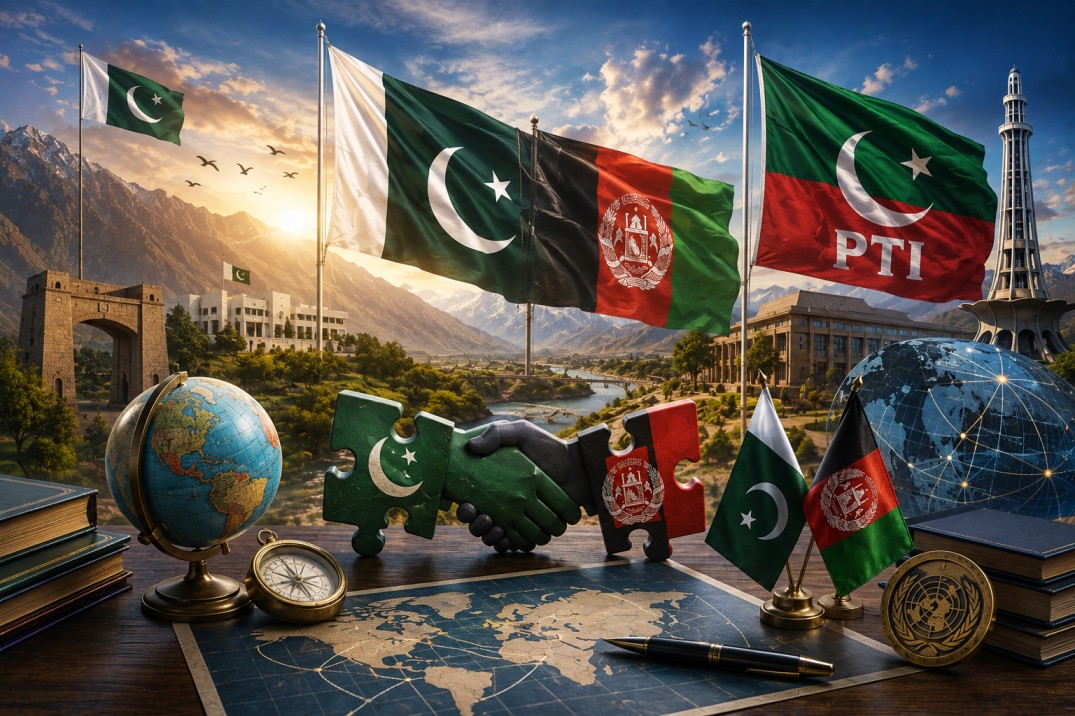
This study examines Pakistan's foreign policy towards Afghanistan during the Pakistan Tehreek-e-Insaf (PTI) government from 2018 to 2022. The PTI administration played a pivotal role in Pakistan's diplomatic engagement with Afghanistan, including the Doha Agreement 2020 and the withdrawal of NATO forces. The research situates Pakistan's policy within its historical and regional context to assess evolving cross-border dynamics. A qualitative research approach was adopted, including Primary data from official statements by the Ministries of Foreign Affairs of Pakistan and Afghanistan, as well as reports from Dawn and Tolo News. Secondary sources comprised academic journals, books, research articles, dissertations, and newspapers. The data were analyzed using a systematic six-step thematic analysis framework. The findings indicate that the PTI government prioritized peacebuilding, regional stability, economic cooperation, and counter terrorism efforts. Challenges such as economic mismanagement and institutional weaknesses persisted. The study concludes that Pakistan’s foreign policy under the PTI administration was comparatively more coherent and proactive, emphasizing the importance of peace in Afghanistan for enduring stability in Pakistan.
##plugins.themes.default.displayStats.downloads##
##submission.citations##
Ahmed, Z. S. (2022). The Taliban’s takeover of Afghanistan and Pakistan’s non-traditional security challenges. Global Policy, 13(1), 125–131. https://doi.org/10.1111/1758-5899.13045
Dawn. (2021, August 17). Imran Khan draws flak for “breaking shackles of slavery” remarks on Afghanistan. https://www.dawn.com/news/1641046
Dawn. (2021, December 19). PM Imran urges the world to “de-link” the Taliban government from the Afghan people. https://www.dawn.com/news/1664507
Fair, C. C. (2014). Fighting to the end: The Pakistan Army’s way of war. Oxford University Press.
Grare, F. (2013). Afghanistan’s future: The impact of domestic and regional changes. Carnegie Endowment for International Peace.
Gul, A. (2021, December 30). Pakistan sends humanitarian aid to Afghanistan. Voice of America. https://www.voanews.com/amp/pakistan-sends-humanitarian-aid-to-afghanistan-/6375649.html
Hashim, A. (2022, January 18). Pakistan’s balancing act with Taliban: Between diplomacy and ideology. Al Jazeera. https://www.aljazeera.com/news/2022/1/18/pakistan-taliban-diplomacy-ideology
Khan, F. H. (2014). The Durand Line: Tribal politics and Pakistan–Afghanistan relations. In T. H. Johnson & B. M. Zellen (Eds.), Culture, conflict, and counterinsurgency (pp. 148–175). Stanford University Press. https://doi.org/10.1515/9780804789219-008
Ministry of Foreign Affairs, Government of Pakistan. (2018, December 15). Third China-Afghanistan-Pakistan Foreign Ministers’ Dialogue. https://mofa.gov.pk/press-releases/third-china-afghanistan-pakistan-foreign-ministers-dialogue-2018/
Ministry of Foreign Affairs, Government of Pakistan. (2018, September 15). Foreign Minister’s visit to Kabul. https://mofa.gov.pk/press-releases/foreign-ministers-visit-to-kabul-15-september-2018/
Ministry of Foreign Affairs, Government of Pakistan. (2021). 17th Extraordinary Session of the OIC Council of Foreign Ministers on the humanitarian situation in Afghanistan. https://mofa.gov.pk
Ministry of Foreign Affairs, Government of Pakistan. (2021). Extraordinary session of the OIC Council of Foreign Ministers on Afghanistan, Islamabad. https://mofa.gov.pk/oic-extraordinary-session-on-afghanistan/
Ministry of Foreign Affairs, Government of Pakistan. (2021). Pakistan’s statement on the situation in Afghanistan. https://mofa.gov.pk/
Ministry of Foreign Affairs, Government of Pakistan. (2021, July 16). Meeting between Prime Minister Imran Khan and President Ashraf Ghani in Tashkent. https://mofa.gov.pk/press-releases/meeting-between-prime-minister-imran-khan-and-president-ashraf-ghani-in-tashkent/
Ministry of Foreign Affairs, Government of Pakistan. (2021, September 15). Statement by Foreign Minister Shah Mahmood Qureshi at UNGA side event on Afghan humanitarian crisis. https://mofa.gov.pk/
Ministry of States and Frontier Regions. (2020). Refugee management in Pakistan: Annual report. Government of Pakistan. http://www.safron.gov.pk/
Nadiri, K. H. (2014). Old habits, new consequences: Pakistan’s posture toward Afghanistan since 2001. International Security, 39(2), 132–168. https://doi.org/10.1162/ISEC_a_00178
Organization of Islamic Cooperation. (2021, December 19). OIC Secretary General and Pakistan Prime Minister discuss the situation in Afghanistan and in Jammu and Kashmir, and Islamophobia. https://www.oic-oci.org/
Rafiq, A. (2021). Pakistan’s strategic ambiguity in post-Taliban Afghanistan. Middle East Institute. https://www.mei.edu/publications/pakistans-strategic-ambiguity-post-taliban-afghanistan
Rafiq, A. (2022). Border fencing and Pakistan’s Western security strategy. Middle East Institute. https://www.mei.edu/publications
Rafiq, A. (2022). Pakistan and Afghanistan: Between regional diplomacy and domestic insecurity. Middle East Institute. https://www.mei.edu/publications/pakistan-and-afghanistan-between-regional-diplomacy-and-domestic-insecurity
Rana, M. A. (2022). Pakistan’s Afghan policy and the narrative gap. Dawn. https://www.dawn.com
Rana, M. A. (2022). Taliban takeover and Pakistan’s policy dilemmas. Pak Institute for Peace Studies Quarterly, 4(1), 11–19.
Rana, M. A. (2022). TTP resurgence and security policy dilemma. Pakistan Institute for Peace Studies. https://www.pakpips.com
Rubin, B. R. (2002). The fragmentation of Afghanistan: State formation and collapse in the international system. Yale University Press.
Shah, S. A. (2022). Counterterrorism in Pakistan’s tribal areas after the US withdrawal. International Crisis Group. https://www.crisisgroup.org
Tolo News. (2020). Afghanistan’s view on Pakistan’s role in peace talks. https://www.tolonews.com/
United Nations High Commissioner for Refugees. (2021). Afghan refugees in Pakistan: Annual report. https://www.unhcr.org/pk
United Nations High Commissioner for Refugees. (2021). Pakistan: Afghan refugee response update—December 2021. https://data.unhcr.org/en/documents/details/90920
United Nations High Commissioner for Refugees. (2022). Pakistan fact sheet—December 2021. https://www.unhcr.org/pk
United Nations High Commissioner for Refugees. (2022). Pakistan: Comprehensive policy framework for Afghan refugees. https://www.unhcr.org
Yousaf, K. (2021, August 30). Pakistan’s cautious optimism about the Taliban’s rule. The Express Tribune. https://tribune.com.pk/story/2317952
Yousaf, K. (2021, December 28). 90% border fencing with Afghanistan complete, says Pakistan Army. The Express Tribune. https://tribune.com.pk/story/2336191
Yousaf, K. (2022). Public opinion and foreign policy shifts: PTI’s dilemma in Afghan relations. Pakistani Journal of Political Science, 38(1), 76–93.
Yousaf, K. (2022, February 5). Taliban govt’s mixed signals pose challenge for Pakistan. The Express Tribune. https://tribune.com.pk
Yusuf, H. (2022). Pakistan’s refugee challenge in the post-Taliban landscape. United States Institute of Peace. https://www.usip.org/publications
Yusuf, M. (2020). Brokering peace in nuclear environments: U.S. crisis management in South Asia. Stanford University Press.
Yusuf, M. (2021). Afghanistan-Pakistan relations: The way forward. Carnegie Endowment for International Peace. https://carnegieendowment.org
Yusuf, M. (2021). Navigating Pakistan’s security and foreign policy challenges after the US withdrawal from Afghanistan. United States Institute of Peace. https://www.usip.org/publications/2021/10/navigating-pakistans-security-and-foreign-policy-challenges-after-us
##submission.downloads##
##submissions.published##
##issue.issue##
##section.section##
##submission.license##
##submission.copyrightStatement##
##submission.license.cc.by4.footer##Authors retain the copyright and full publishing rights of their work. All articles published in Scholar Insight Journal are licensed under the Creative Commons Attribution 4.0 International License (CC BY 4.0).
Under this license, readers are permitted to read, download, copy, distribute, print, search, link to the full texts, and reuse the published articles for any lawful purpose, including adaptation and commercial use, provided that appropriate credit is given to the original author(s), the source of publication, and the license terms are properly acknowledged.
The journal retains the right of first publication while authors maintain ownership of their intellectual property rights without restrictions.