
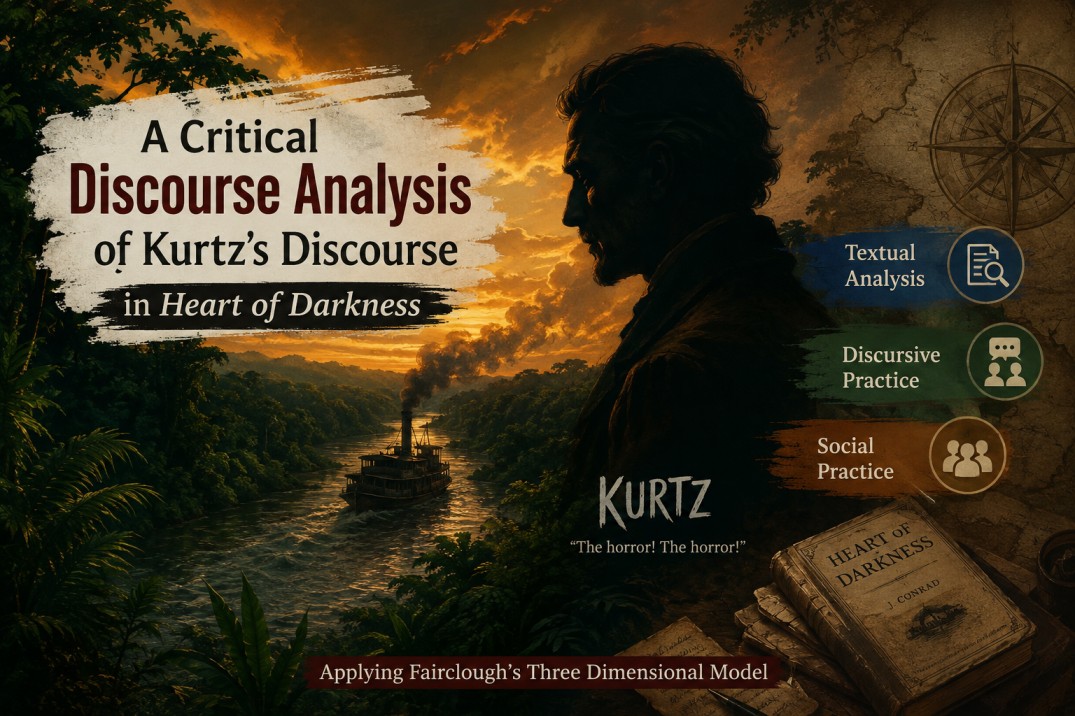
A Critical Discourse Analysis of Kurtz’s Discourse in Joseph Conrad’s Heart of Darkness Applying Fairclough Three Dimensional Model
Keywords:
Kurtz’s discourse, Heart of Darkness, European, socio-cultural practice, AfricansAbstract
This study examines the construction of colonial power, identity, and imperial ideology in Joseph Conrad’s Heart of Darkness by applying Norman Fairclough’s three-dimensional framework of Critical Discourse Analysis (CDA). Utilizing Fairclough’s model comprising linguistic description, discursive interpretation, and sociocultural explanation the research investigates how Kurtz’s language reflects and reinforces nineteenth-century European hegemonies. At the textual level, the analysis focuses on Kurtz’s lexical choices, evaluative structures, and racialized binary representations that separate Europeans from native Africans. At the level of discourse practice, the paper evaluates how Kurtz’s written report functions as a communicative event, reproducing institutional colonial rhetoric and civilizing narratives. At the sociocultural level, the findings contextualize Kurtz’s utterances within broader imperialist structures, racial hierarchies, and the moral justifications of colonial expansion. Special analytical focus is placed on the ideological rupture between his high-minded humanitarian preamble and his infamous postscript, "Exterminate all the brutes!" This paradoxical shift reveals the fragility and inherent hypocrisy of imperial rhetoric. The study concludes that Kurtz’s discourse operates dualistically: while it seeks to rationalize and sustain colonial dominance, it ultimately unmasks the systemic brutality, moral decay, and structural contradictions embedded within the Western imperial enterprise. By deconstructing these discursive layers, the research highlights the pivotal role of critical language analysis in exposing how literature both reproduces and interrogates colonial power dynamics.
Downloads
References
Dei, G. J. S., & Asghar zadeh, A. (2001). The power of social theory: The anti-colonial discursive framework. The Journal of Educational Thought (JET) / Revue De La Pensée Éducative, 35(3), 297–323.
Elass, H. (2025). Rethinking the theoretical foundations of Quran translation: A case against instrumentalism. FORUM: International Journal of Interpretation and Translation, 23(2), 242–273.
Frayne, B. (2000). Political ideology, social change, and planning practice in Namibia. Journal of Planning Education and Research, 20(1), 52–65.
Hart, C. (2018). Event-frames affect blame assignment and perception of aggression in discourse on political protests: An experimental case study in critical discourse analysis. Applied Linguistics, 39(3), 400–421.
Hu, D., & Wang, C. (2025). Hybrid media warfare: Discourse analysis of Russian and Ukrainian MFA websites on the Bucha Incident. Telematics and Informatics Reports, 20, Article 100256.
Lotfipoursaedi, K. (2025). More about text, textuality and discourse analysis. Iranian Journal of Language Teaching Research, 13(1), 145–149.
Magubane, B. (1982). A critical look at indices used in the study of social change in colonial Africa. Current Anthropology, 23(4), 412–430.
Mandal, S. (2022). Colonial ideology: A lens for critical understanding of education system. Journal of Progressive Education, 23(11), 234–240.
Mosse, D. (1997). Colonial and contemporary ideologies of ‘community management’: The case of tank irrigation development in South India. Modern Asian Studies, 31(1), 21–70.
Plange, N. K. (2021). Re-thinking colonialism and social policy: With the logic of imperialism. Social Sciences & Humanities Open, 3(1), Article 100111.
Rogers, R., & Martin-Beltrán, M. (2005). Critical discourse analysis in education: A review of the literature. Review of Educational Research, 75(5), 78–79.
Roy, S. (2004). A critical discourse analysis of representation of Asian Indian folk tales in US-American children's literature. CLC Web: Comparative Literature and Culture, 6(2), 1–9.
Scollon, S. (2003). Political and somatic alignment: Habitus, ideology and social practice. In G. Weiss & R. Wodak (Eds.), Critical discourse analysis: Theory and interdisciplinary (pp. 79–98). Palgrave Macmillan.
Sipra, M. A., & Rashid, I. (2013). Critical discourse analysis of Martin Luther King's speech in socio-political perspective. SSRN Electronic Journal. https://doi.org/10.2139/ssrn.2345678
Stibbe, A. (2010). An ecolinguistic approach to critical discourse studies. Critical Discourse Studies, 7(2), 117–128.
Tussa'diah, H., & Wijaya, A. (2023). Critical discourse analysis on linguistic ideology of the netizens comments. Journal on Recent Innovation, 5(1), 46–49.
Wodak, R. (2006). Analysing the politics of denial: Critical discourse studies and the discourse-historical approach. In I. Fairclough & G. Fairclough (Eds.), Discourses in action (pp. 12–23). Routledge.
Zotzmann, K., & O’Regan, J. P. (2016). Critical discourse analysis and identity. In S. Preece (Ed.), The Routledge handbook of language and identity (pp. 89–102). Routledge.
Downloads
Published
Issue
Section
License
Copyright (c) 2026 Allah Noor, Abrar Ahmad, Mohammad Faheem (Author)

This work is licensed under a Creative Commons Attribution 4.0 International License.
Authors retain the copyright and full publishing rights of their work. All articles published in Scholar Insight Journal are licensed under the Creative Commons Attribution 4.0 International License (CC BY 4.0).
Under this license, readers are permitted to read, download, copy, distribute, print, search, link to the full texts, and reuse the published articles for any lawful purpose, including adaptation and commercial use, provided that appropriate credit is given to the original author(s), the source of publication, and the license terms are properly acknowledged.
The journal retains the right of first publication while authors maintain ownership of their intellectual property rights without restrictions.