اسلامی اور مغربی معاشروں میں خواتین کی خود مختاری کے اثرات: ایک تقابلی جائزہ
The Impact of Female Autonomy in Islamic and Western Societies: A Comparative Study
DOI:
https://doi.org/10.68024/7z08jf05Keywords:
female autonomy, Islamic and Western societies, social cohesion, Family DynamicsAbstract
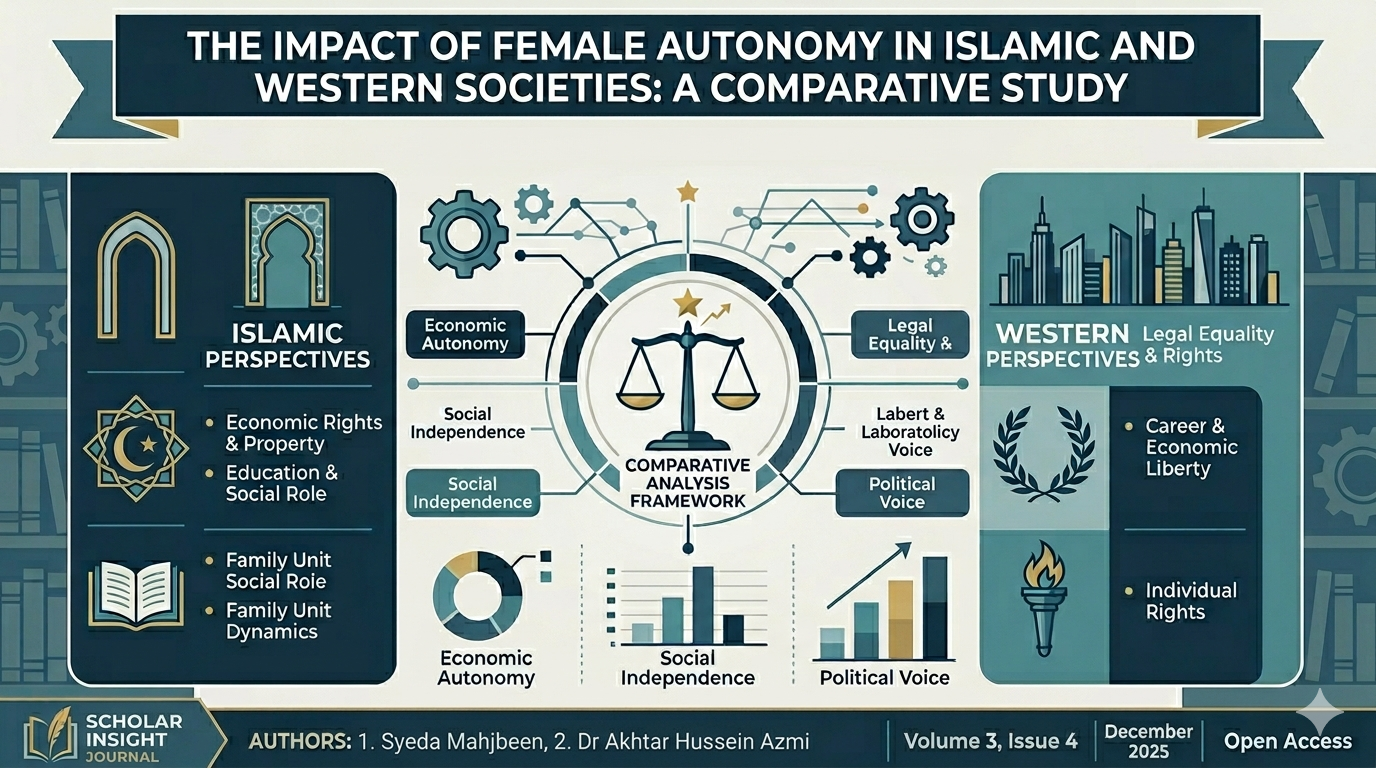
This study presents a comparative analysis of the effects of female autonomy in Islamic and Western societies. The concept of women’s autonomy differs significantly between these two social frameworks, influenced by distinct cultural, religious, and societal values. In Islamic societies, female autonomy is viewed within the boundaries of Islamic principles, ensuring respect, dignity, and rights for women, while also maintaining certain restrictions to preserve the moral fabric of society. Islam grants women autonomy in various aspects of life, including spiritual, social, and economic domains, but it places emphasis on the notion of balance and responsibility within a structured framework. In contrast, Western societies generally promote female autonomy based on individual freedom, equality, and personal rights. Women in these societies have been granted greater personal liberties, particularly in areas such as education, employment, and politics. However, this unrestricted autonomy sometimes comes with negative consequences, such as the destabilization of family structures, pressures in balancing career and family life, and challenges to traditional gender roles. This study explores the positive and negative effects of women’s autonomy in both contexts, emphasizing its impact on societal stability, family dynamics, and personal well-being. While women’s autonomy in Islamic societies is seen as a balanced approach that ensures social cohesion and individual development within the limits of religious ethics, the Western approach often emphasizes absolute freedom, sometimes leading to unintended social consequences. Furthermore, the study highlights the role of women in modern times, particularly focusing on the growing challenges and opportunities provided by the digital age, which has further reshaped the concept of autonomy.
Downloads
References
1. The Holy Qur'an
2. Ibn Sa'd. (1990). Kitab al-Tabaqat al-Kabir (S. M. Haq, Ed.). Pakistan Historical Society.
3. Ibn Asakir. (2005). Tarikh Dimashq. Dar al-Fikr.
4. Ibn Hisham. (1986). Sirat al-Nabawiyya. Dar al-Fikr.
5. Maududi, A. A. (1960). Islami tarz-e-zindagi [Islamic way of life]. Islamic Publications Ltd.
6. Maududi, A. A. (1972). Parda aur Islam mein aurat ki haisiyat [Purdah and the status of women in Islam]. Islamic Publications Ltd.
7. Aijaz. (2021). Khawateen ki tehreek aur jadeed muashira [Women's movement and modern society]. Fahm Publications.
8. Iqbal, M. (1930). Islam mein mazhabi fikr ki tashkeel-e-nau [The reconstruction of religious thought in Islam]. Sheikh Muhammad Ashraf.
9. Al-Ghazali, Imam. (2004). Islam mein khawateen [Women in Islam]. Islamic Book Trust.
10. Naz, S. (2020). Aurat, zehni sehat aur azadi [Woman, mental health, and freedom]. National Book Foundation.
11. Ghamidi, J. A. (2009). Meezan. Al-Mawrid.
12. Badawi, J. A. (1995). Islam mein sinfi musawat [Gender equity in Islam]. American Trust Publications.
13. Hallaq, W. B. (2005). Islami qanoon ki ibtida aur irtiqa [The origins and evolution of Islamic law]. Cambridge University Press.
14. Al-Anbari, K. (2015). Seerat-un-Nabi (PBUH) mein khawateen ka kirdar [The role of women in the Prophetic biography]. Darussalam.
15. Hassan, R. (2006). Islam aur khawateen ke huqooq [Islam and women's rights]. Rehman Publications.
16. Hassan, R. (2006). Post-modern hijab: Re-defining women’s roles in Muslim societies. Journal of Islamic Studies.
17. Shaheen, Z. (2012). Pakistani khawateen aur maishiyat [Pakistani women and economy]. Danish Publishers.
18. Aftab, S. (2013). Samaji taraqqi aur khawateen ka kirdar [Social development and the role of women]. Al-Fatah Academy.
19. Nasr, S. H. (1976). Islami science: Aik tasveeri mutala [Islamic science: An illustrated study]. World of Islam Festival Trust.
20. Qutb, S. (1980). Quran ke saye mein [In the shade of the Qur'an]. Islamic Foundation.
21. Al-Tabari. (1967). Tarikh al-Rusul wa al-Muluk. Dar al-Ma'arif.
22. Al-Alwani, T. J. (1993). Islam mein ikhtilaf ki akhlaqiyat [The ethics of disagreement in Islam]. International Institute of Islamic Thought (IIIT).
23. Khan, Z. (2011). Islam mein khandani nizam [Family system in Islam]. Dar-ul-Ishaat.
24. Firdaus. (2022). Islam aur niswani khud-mukhtari [Islam and female autonomy]. Islamic Research Institute.
25. Al-Jaziri, A. R. (1985). Al-Fiqh 'ala al-madhahib al-arba'ah. Dar al-Kutub.
26. Shakeel, F. (2015). Khawateen ki siyasi shirkat: Pakistan ka tanazur [Women's political participation: Pakistan's perspective]. National Book Foundation.
27. Al-Qurtubi. (1967). Tafsir al-Qurtubi. Dar al-Kutub al-Misriyya.
28. Qureshi. (2021). Aurat, khandan aur jadeediyat [Woman, family, and modernity]. University of Karachi Press.
29. Qureshi, Q. (2010). Islam mein khawateen ka maqam [The status of women in Islam]. Idara Ma'arif-e-Islami.
30. Kamali, M. H. (2008). Islami fiqh ke usool [Principles of Islamic jurisprudence]. Islamic Texts Society.
31. Mirza. (2018). Taleem-e-niswan aur khud-iradiyat [Women's education and self-determination]. Sang-e-Meel Publications.
32. Shereen, M. (2012). Islam mein khawateen ka siyasi kirdar [Political role of women in Islam]. National Book Foundation.
33. Nadvi, S. S. (1999). Khilafat-o-Mulukiyat. Idara-e-Talimat-e-Ahle-Sunnat.
34. Nasr, S. H. (2002). The heart of Islam: Enduring values for humanity. HarperCollins.
35. Ali, Y. (2005). Islam mein khawateen ka maqam [Status of women in Islam]. Islamic Book Service.
English Sources
36. Robinson, A. (2015). The role of women in modern society. Harper & Row.
37. Miller, C. (2016). Gender roles and family life in the West. University of Chicago Press.
38. Deci, E. L., & Ryan, R. M. (1985). Intrinsic motivation and self-determination in human behavior. Plenum Press.
39. Fanon, F. (2004). The wretched of the earth (R. Philcox, Trans.). Grove Press. (Original work published 1961).
40. Wells, H. (2019). Social dimensions of female autonomy. Columbia University Press.
41. Kant, I. (1997). Groundwork for the metaphysics of morals (M. Gregor, Trans.). Cambridge University Press.
42. Berlin, I. (1969). Four essays on liberty. Oxford University Press.
43. Huckaby, J. (2020). Women and economic liberty. Cambridge University Press.
44. Esposito, J. L. (2011). What everyone needs to know about Islam. Oxford University Press.
45. Locke, J. (2003). Two treatises of government. Oxford University Press.
46. Mill, J. S. (1859). On liberty. John W. Parker and Son.
47. Martin, J. (2020). The work-life balance crisis in the West. Oxford University Press.
48. Journal of Child Development. (2020). Work-life balance and parenting. Routledge.
49. Journal of Gender Studies. (2021). Social impact of women's empowerment. Sage Publications.
50. Butler, J. (1990). Gender trouble: Feminism and the subversion of identity. Routledge.
51. Brown, L. (2018). Gender and education in modern society. Cambridge University Press.
52. Brown, L. (2021). Women in the digital age. MIT Press.
53. Nussbaum, M. C. (2000). Women and human development: The capabilities approach. Cambridge University Press.
54. Johnson, M. (2022). Women in the workforce. HarperCollins.
55. National Institute of Child Health and Human Development. (2021). Parenting and child outcomes.
56. McDonald, N. (2018). Women in modern politics. Oxford University Press.
57. Gale, R. (2019). Gender and role redefinition. Harvard University Press.
58. Robert, S. (2001). Women and reform in the West. Oxford University Press.
59. Taylor, S. (2017). Women in politics: A global perspective. Routledge.
60. UN Women. (2016). Turning promises into action: Gender equality in the 2030 agenda for sustainable development. United Nations.
61. US Congress. (1994). Violence Against Women Act of 1994. Government Printing Office.
62. Foster, W. (2018). The impact of feminism on family structure. Princeton University Press.
63. World Bank. (2020). Women, business and the law 2020. World Bank Group.
Downloads
Published
Issue
Section
License
Copyright (c) 2025 Syeda Mahjbeen, Dr Akhtar Hussein Azmi (Author)

This work is licensed under a Creative Commons Attribution 4.0 International License.
Authors retain the copyright and full publishing rights of their work. All articles published in Scholar Insight Journal are licensed under the Creative Commons Attribution 4.0 International License (CC BY 4.0).
Under this license, readers are permitted to read, download, copy, distribute, print, search, link to the full texts, and reuse the published articles for any lawful purpose, including adaptation and commercial use, provided that appropriate credit is given to the original author(s), the source of publication, and the license terms are properly acknowledged.
The journal retains the right of first publication while authors maintain ownership of their intellectual property rights without restrictions.